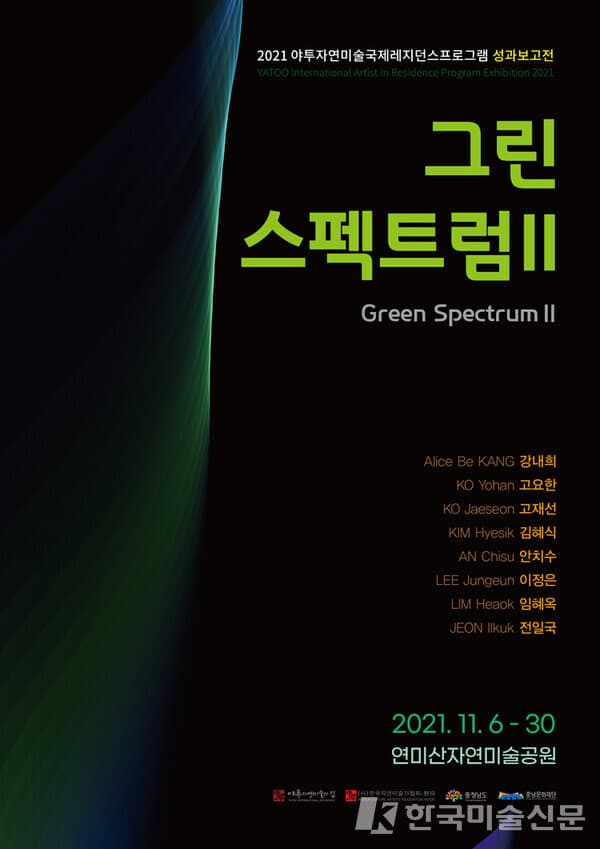
2020년에 이어 한국자연미술협의회가 주관하는 2021 야투자연미술국제레지던스프로그램에 참관하여 작가들과 대담하고 소견을 주고받을 수 있는 기회를 얻었다. 회화적 요소와 달리 자연 미술 영역을 넘나드는 다양한 조형물 설치와 사진 작업의 결과물들이 전시되었다. 자연 미술의 확장성을 높이기 위한 시도라고 할 수 있고, 장르의 구분을 뛰어넘거나 혼종 과정을 조형화한다는 의미 있는 행위로 볼 수 있을 것이다. 그런 점에서 서정과 서사를 통해 자연의 형상을 그려내는 예술적 성과라는 기대를 할 수 있겠다.
이 프로그램에 참여하면서 필자는 우연히 두 컷의 그림을 떠올렸다. 그 하나는 연기(세종시) 동면 출신의 화가 장욱진을 떠올렸다. 그가 남긴 작품 중 필자는 <자화상>(1951년)에 집착한다. 엽서 한 장 크기 종이에 채색한 그림인데 구름이 떠 있는 하늘과 나무 한두 그루가 있는 노란 들판, 그 들판을 경사진 가로와 세로로 길게 꺾어 이어진 붉은 길, 댄디풍의 신사, 그 뒤를 따르는 강아지, 그리고 까치 혹은 제비들이 이어져 날고 있다. 아주 단순한 구조와 그득한 풍경이 인상적인 그림이다. 다른 하나는 네덜란드 반 고흐 미술관에서 본 <까마귀가 나는 밀밭>(1890)인데, 구름이 보이는 검푸른 하늘에 닿은 밀밭을 가로 세로로 이어지는 흙길과 그 위를 나는 까마귀들의 풍경이다. 이 풍경 속에 인물은 보이질 않으나 밀밭 사이의 길에는 숱한 움직임의 흔적이 직선과 곡선이 혼재되어 표현되어 있으니 보이지 않는다고 하여 인물이 없을 것이라 단정할 수 없다. 이 두 작품 속에서 필자는 색상 대비에서 느끼는 선명함과 역동성을 느꼈지만 다른 한편 지독한 고독이 함의되어 있음을 알고 놀라곤 한다.
시공을 뛰어넘는 두 작품에서 공감하는 근원적 고독은 그들의 다른 작품 거목의 존재와 역동적인 생명의 움직임을 결합한 장욱진의 <거목>(1954)과 고흐의 <별이 빛나는 밤>(1889)에도 드러나 있다. 그 고독은 자연 속에 존재하는 인간에 대한 인식이다. 큰 자연과 압축되고 줄어든 인간의 일상(두 그림에서 낮은 건물들로 표현된 모습)을 대비시킨 두 화가의 고민이 결국 풍경 속에 잠긴 자연의 위대함에 대한 경외가 아닌가 한다.
그렇다면 자연과 인간이 대비되는 실존적 가치를 찾으려는 인식의 바탕은 무엇일까 되새길 필요가 있다. 엄연했던 자연 그리고 인간이었던 자연론의 실체가 어느 순간 인간과 자연으로 그 우선순위를 뒤바꾸고 인성과 물성으로 구분하여 인식하게 된 바탕은 무엇인가 묻지 않을 수 없다. 이러한 의문은 그동안 금강 유역에서 오래동안 논쟁해 온 인물성동론(낙론)과 인물성이론(호론)으로 나뉜 성리학적 접근에서 비롯된 것은 아닐까라는 것이다. 이번 전시를 통해 새삼 인성(인간)과 물성(자연)을 다시 생각하게 하는 계기가 된다.
■ 물성物性을 어떻게 볼 것인가
사서의 하나인 『대학大學』은 격물格物과 치지致知를 근본으로 삼아 성의誠意와 정심正心으로 수신修身에 이르고 제가齊家와 치국治國을 이루어 평천하平天下에 이른다고 기술한다. 주희 선생은 온갖 물상들이 사는 시간과 공간에서 나무 한 그루, 풀 한 포기도 그 나름의 이치를 갖추고 있으며 그 이치를 따져 살펴봐야 비로소 제대로 아는 경지에 이를 수 있다고 말한다. 이렇게 물성을 따지는 과정을 격물이라 말하고 물성을 아는 것을 치지라고 한다. 그런데 우리가 알게 되는 물성은 그 스스로 이치를 지닌 자연이다. 자연은 그 스스로 이치를 지녀 움직임을 일으키고 서로 작용하여 생명현상을 이룬다. 해월 최시형은 살아 움직이며 작용하는 것은 그것이 물성이든 인성이든 다를 것이 없다고 하여 인성과 물성이 하나임을 경물론敬物論으로 간파한 바 있다.
간혹 경물론을 일종의 숭배론으로 보고 영성을 부여한 원시신앙으로 여겨 마치 접신이나 접령의 애니미즘이나 토템의 하나로 보는 이도 있다. 그러나 실제 경물론은 자연에서 비롯되는 현상에 영성을 부여하는 한 방식일 뿐이다. 물론 이러한 영성적 접근 또한 자재연원自在淵源을 밝혀내는 예술 분야에서 작가 나름의 접근 방식이 될 수 있을 것이다.
다른 곳과는 달리 금강 유역의 야투자연미술은 서로 작용하는 생명현상의 근원을 찾아 미술작품으로 펼쳐내는 예술활동이다. 이런 활동을 금강 유역에서 심화된 인성과 물성의 관계를 찾는 탐색의 또 다른 모습이라 생각한다. 우연이라고 치부하기는 너무도 놀라운 자연미술 활동은 물성의 근원을 궁구하고 작동의 원리를 알고자 하는 성리학적 접근의 한 방편으로 여길 수도 있다. 더구나 이런 일련의 탐미적 활동이 금강 유역에서 비롯되었으나 점차 그 범주를 넓혀 대륙을 넘나들고 전 지구적 미술활동의 한 지평을 이루고 있으니 참으로 즐거운 일이 아닐 수 없다.
2019년 여름, 로키산맥을 남북으로 가로지르며 알래스카를 여행한 적이 있다. 북아메리카의 원주민 상당수는 자신들의 언어가 사라지는 것을 우려하고 영어로 바뀐 지명을 원주민들의 언어로 복원하는 운동을 벌이고 있는 것을 보았다. 원주민들은 자신들의 언어와 퉁구스, 몽골, 한국, 일본 등지의 언어와 비교 연구하여 유사성에서 자신들의 근원을 찾아 원주민 문화박물관에 기록으로 남기고 있다. 그런데 그 원주민들의 언어 못지않게 주목하는 것은 원주민들의 생활양식을 정리한 문화 도구들이다. 물론 이러한 생활문화 도구들은 사진 자료들이나 그림으로 그려 정리한 것들인데, 특히 원주민들이 남긴 벽화들은 그 유래를 어렵지 않게 유추할 수 있었다. 그것은 무엇보다 물성을 중시하는 회화적 대물림이라 할 것이고 이는 집단무의식의 발로라고 봐야 한다. 유구한 역사성을 지닌 집단무의식은 보이는 물성에서 기인하여 보이지 않는 영성으로 전이되고 새로운 실체로 자리 잡고 유기체적인 구조물로 드러날 것이기 때문이다. 이러한 전이 과정은 미술의 한 방법론으로 발상되어 변이의 과정을 겪고 있는 자연미술에서 체계화되어 보완 정리될 필요가 있겠다고 생각했다.
코로나19로 비롯된 팬데믹 상황이 어떻게 전개될지 알 수 없다. 이런 상황에서 인간들이 불확실성을 견딜 수 있게 하는 힘은 무엇일까 하는 의문을 지울 수 없다. 이런 의구심은 유사 이래 끊임없이 탐색해 온 자연의 실체에 대한 선명한 해결책을 마련하지 못한 현대 과학의 한계에서 비롯된 것이라 할 것이다. 결국 과학으로 입증하려던 연구과제는 더 이상 가시화된 실체로 정리될 수 없는 근원적 문제라는 것을 되새기게 되었다. 이러한 위난의 시기에 야투자연미술 참여 작가들이 자연의 근원적 현상을 치열하게 탐색하여 엄연히 존재하는 미확인 물상을 가시화하여 보여주었다. 놀라운 일이나 이러한 시도는 가히 과학의 한계를 딛고 근원을 찾는 예술 활동이라 할 것이다.
2021년 야투자연미술레지던스프로그램에 참여한 작가들이 보여준 작품들은 현상에 안주하지 않고 극복하려는 반성적 활동의 실체다. 이는 원효가 일찍이 화쟁和諍의 양상으로 제시한 비연비불연非然非不然에 다르지 않다. ‘그렇지 않고, 그렇지 않은 것도 아닌’ 부정과 부정의 부정이란 변증의 실상을 보여주는 것이다.
■ 검증의 실체로서 변증의 실상 보여주기
야투자연미술레지던스 프로그램이 펼쳐지는 주 공간은 연미산 자연미술 공원이다. 연미산 자연미술 공원에 설치된 작품들은 실상을 되돌아보고 팬데믹 상황을 견딜 수 있는 작품에 의미를 부여하였다. 또한 연미산을 벗어나 금강 유역으로 그 범주를 확대하여 새들목과 죽당리 인근에서 전개되는 자연 현상의 예기치 못한 변이를 파고들어 자연이 보여주는 실상과 드러내지 않는 의미를 구체화했다.
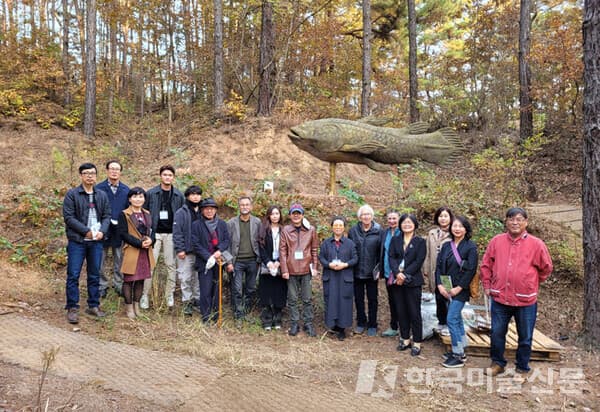
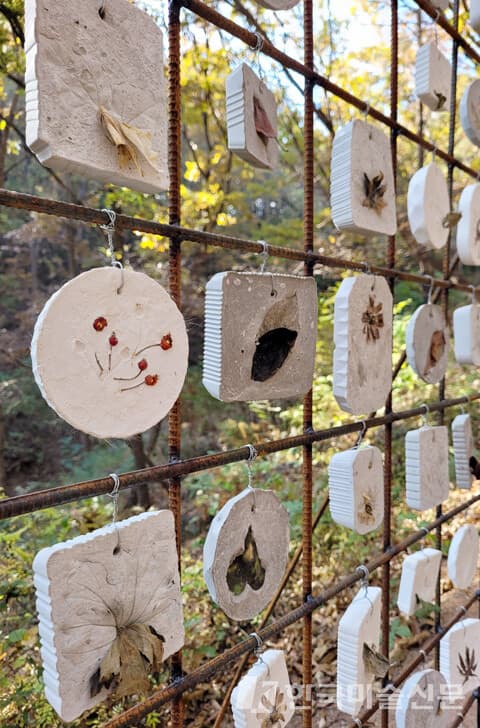
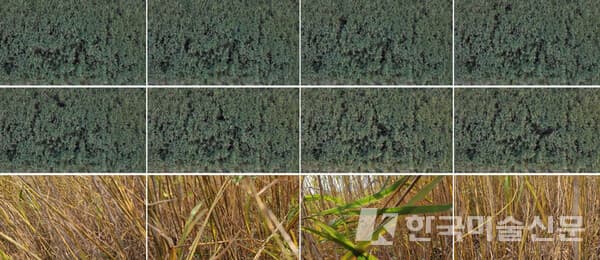
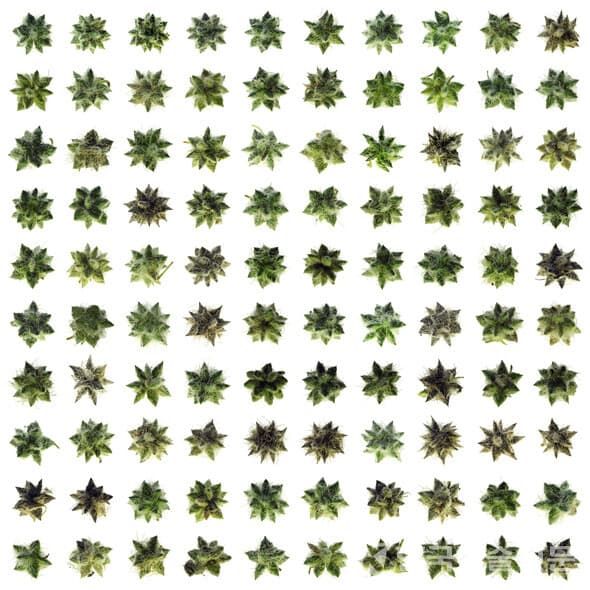
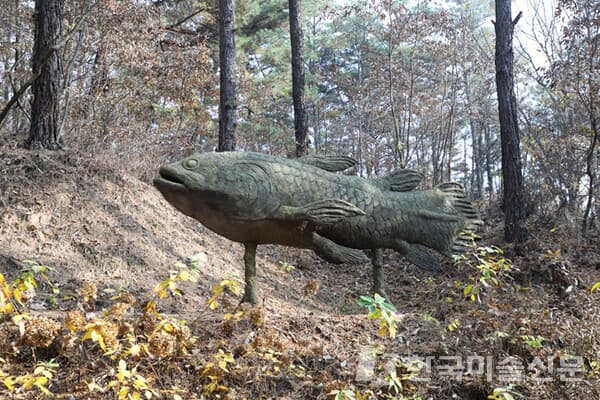
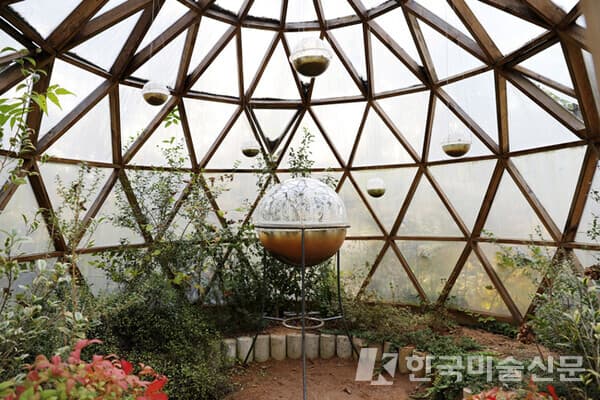
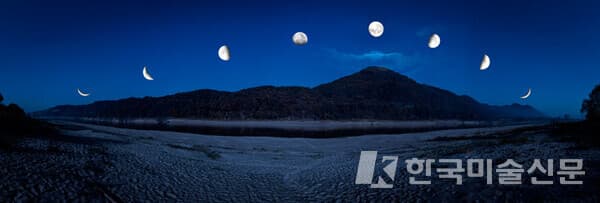
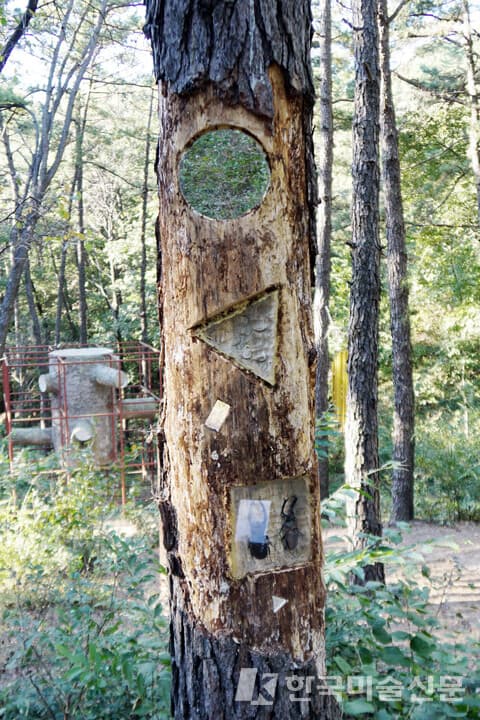
강내희와 고재선은 공간에 설정된 의미를 부여하여 보이는 현실과 보이지 않는 실체를 동시에 드러내어 공존하는 삶과 그 안에서 갈등하는 인간의 삶의 단면을 그려냈다. 안치수는 화석어류 실러캔스를 재현하여 시공을 초월한 가능세계의 실체를 제시했고, 임혜옥은 사진 작업을 통해 연미산과 금강 고마나루에 전승되는 설화를 자연변이의 현실 모습으로 그려냈다. 전일국은 흔적으로 남은 소나무 등걸에 설치 작업으로 보여지는 것과 비춰지는 것을 대비하여 인간의 내면을 완곡하게 드러내려 했다. 이정은의 작업은 생물학적 현상과 화학적 현상이 결합된 가설을 세우고 실험적 방식을 통해 자연 현상이 소리치는 아우성을 전달한다. 물론 그 아우성을 현실음으로 듣기에는 제한적이지만 실상을 부정할 수 없고, 기포의 움직임 등으로 미루어 짐작할 수 있다. 죽당리 억새 숲으로 나간 고요한은 생명현상이 무성한 자연 공간에 가해진 인간의 가학적 억압과 파괴를 딛고 일어서는 자연성을 유희적 퍼포먼스로 보여준다. 김혜식의 가시박은 환유적 시각으로 찾아낸 새로운 발견이다. 가시박의 실체는 상식을 벗어나 변이과정으로 증식하고 번성하여 기존의 자연 질서를 교란하고 파괴하는 모습을 드러낸다. 작품으로 제시한 가둔 가시박 표본들은 가시박으로부터 기존의 자연을 지켜내려는 작가의 간절한 소망이다.
작가들의 작업은 궁극적인 낙관성을 유지한다. 이는 보이지 않는 가능성의 세계에 대한 확신으로 비롯된다. 이러한 낙관적 자세는 야투자연미술이 던지는 미래에 대한 소신이다. 굳이 인성을 보여주지 않는다고 하여 물성의 탐구로 멈춘 것이 아니라는 것은 야투자연미술의 즐거운 상상이고 경험적 소산이기 때문이다. 새삼 경물론에 담길 수 있는 영성을 기대한다.
Following 2020, I attended the 2021 Yatoo Natural Art International Residence Program hosted by the Korea Nature Art Council, and got an opportunity to boldly exchange opinions with artists. Unlike pictorial elements, the results of various sculpture installations and photographic works that cross the realm of nature art were exhibited. It can be said to be an attempt to increase the scalability of nature art, and it can be seen as a meaningful act of transcending genre division or modeling a hybrid process. In this respect, it can be expected that it is an artistic achievement that draws the shape of nature through lyricism and narrative.
While participating in this program, I accidentally came up with two pictures. One of them reminded me of Jang Uk-jin, a painter from Dong-myeon, Yeongi (Sejong City). Among the works he left behind, I am obsessed with <Self-portrait> (1951). It is a colored painting on a piece of postcard-sized paper, showing a sky with clouds, a yellow field with one or two trees, a red road that curves vertically and horizontally through the field, a dandy-style gentleman, a dog following him, and a magpie. Or the swallows are flying in succession. It is an impressive painting with a very simple structure and rich scenery. The other is <Wheatfield with Crows> (1890), which I saw at the Van Gogh Museum in the Netherlands. It is a landscape of a dirt road running horizontally and vertically through a wheat field touching a dark blue sky with clouds, and crows flying over it. There are no figures in this landscape, but traces of numerous movements are expressed in a mixture of straight lines and curves on the road between the wheat fields. In these two works, I felt the vividness and dynamism I felt from the color contrast, but on the other hand, I was surprised to find out that the terrible solitude was implied.
The fundamental solitude shared by the two works that transcend time and space is also revealed in their other works, Jang Uc-jin's <Giant Tree> (1954) and Van Gogh's <Starry Night> (1889), which combine the existence of a giant tree with the dynamic movement of life. That solitude is the recognition of human beings who exist in nature. The concerns of the two painters who contrasted the large nature with the compressed and reduced human daily life (expressed as low buildings in the two paintings) are ultimately awe of the greatness of nature immersed in the landscape.
If so, it is necessary to reflect on what is the basis of cognition to find the existential value that contrasts nature and human beings. We cannot help but ask what is the basis for recognizing the substance of naturalism, which was stern nature and human beings, at some point changed its priority to human and nature and divided it into human nature and physical nature. This question is that it may originate from the Neo-Confucian approach, which has been debated for a long time in the Geumgang River basin, divided into the theory of personality (nakron) and the theory of character (horon). Through this exhibition, it serves as an opportunity to rethink humanity (humanity) and materiality (nature).
■ How to view physical properties
『Daehak Daehak』, one of the librarians, writes that with sincerity and sincerity, based on Gyeokmul and wisdom, one attains to one's own body, governs one's own family, and governs one's country, leading to peace under the world. Teacher Juhee says that in the time and space where all kinds of objects live, even a tree or a blade of grass has its own logic, and it is only by examining the logic that one can reach the realm of knowing it properly. This process of evaluating physical properties is called gyeokmul, and knowing physical properties is called chi. However, the materiality we come to know is nature with its own logic. Nature has its own reason, causes movement, and forms life phenomena by interacting with each other. Haewol Choi Si-hyeong said that there is no difference between the material nature and the human nature of things that are alive and functioning, and he has found out that personality and material nature are one through the theory of karma.
Sometimes, there are those who view the theory of religion as a kind of worship theory and regard it as a primitive religion endowed with spirituality, as if it were one of the animism or totem of god or spirit. However, the theory of the real world is only one way of giving spirituality to phenomena that originate from nature. Of course, this spiritual approach can also be an artist's own approach in the field of art that reveals the natural source.
Unlike other places, Yatoo Yeon Art in the Geumgang River basin is an artistic activity that seeks the source of life phenomena that interact with each other and unfolds them as works of art. I think this activity is another aspect of the search for the relationship between personality and materiality that has deepened in the Geumgang River basin. Nature art activities, which are too surprising to be dismissed as coincidences, can be regarded as a way of approaching Neo-Confucianism to seek the origin of material properties and to know the principles of operation. Moreover, although this series of aesthetic activities originated in the Geumgang River basin, they gradually broadened their scope to cross continents and form a horizon of global art activities, which is truly enjoyable.
In the summer of 2019, I traveled to Alaska, crossing the Rocky Mountains from north to south. I saw that many of the indigenous people of North America were concerned about the disappearance of their language and started a campaign to restore place names that had been changed to English into their language. Aboriginal people compare and study their language with the language of Tungus, Mongolia, Korea, Japan, etc., find their origin in similarity, and leave a record in the Aboriginal Culture Museum. However, what draws attention as much as the language of the natives is the cultural tools that organize the lifestyle of the natives. Of course, these living and cultural tools are drawn and organized using photographic materials or pictures. In particular, the origins of the murals left by the aborigines could be inferred without difficulty. It will be said to be a pictorial inheritance that values materiality above all else, and this should be seen as an expression of collective unconsciousness. This is because the collective unconscious, which has a long history, will be transferred to invisible spirituality based on visible materiality, take root as a new entity, and will be revealed as an organic structure. I thought that this transition process would need to be systematized and supplemented in nature art, which was conceived as a methodology of art and is undergoing a process of transformation.
It is not known how the pandemic situation caused by Corona 19 will develop. In this situation, it is impossible to erase the question of what forces enable humans to endure uncertainty. This doubt stems from the limitations of modern science, which has failed to provide a clear solution to the reality of nature, which has been constantly explored since the beginning of time. In the end, I was reminded that the research task that I was trying to prove with science is a fundamental problem that can no longer be organized as a visible entity. In this time of crisis, the participating artists of Yatoo Nature Art fiercely explored the fundamental phenomena of nature and visualized unidentified objects that clearly existed. Surprisingly, this attempt can be said to be an artistic activity to overcome the limitations of science and find the source.
The works shown by the artists who participated in the 2021 Yatoo Yeon Art Residence Program are the reality of reflective activities to overcome rather than settle for the status quo. This is not different from the non-yeonbi-bulyeon-bi-yeon-bi-bul-yeon (不然不不然) that Wonhyo suggested as an aspect of the theory of harmony early on. The denial of 'not so, not so' and the denial of negation show the reality of dialectics.
■ Showing the reality of dialectics as the substance of verification
The main space for the Yatoo Natural Art Residence Program is Yeonmisan Natural Art Park. The works installed in Yeonmisan Nature Art Park looked back on the reality and gave meaning to works that could withstand the pandemic situation. In addition, by extending the scope to the Geumgang River basin beyond Mt. Yeonmi, he delved into unexpected changes in natural phenomena that developed near Sadeulmok and Jukdang-ri, and embodied the reality that nature shows and the hidden meaning.
Kang Nae-hee and Ko Jae-seon gave set meaning to the space, revealing the visible reality and the invisible reality at the same time, drawing a cross-section of coexisting life and human life in conflict. Ahn Chi-soo reproduced the fossil fish coelacanth to present the reality of a possible world that transcends time and space, and Lim Hye-ok portrayed the folk tales handed down in Mt. Jeon Il-guk tried to euphemistically reveal the inner side of human beings by contrasting what is seen and what is reflected through installation work on the stump of a pine tree left as a trace. Jeongeun Lee's work establishes hypotheses combining biological and chemical phenomena, and conveys the cries of natural phenomena through experimental methods. Of course, it is limited to hear the clamor as a realistic sound, but the reality cannot be denied, and it can be guessed from the movement of air bubbles. Going out to the silver grass forest in Jukdang-ri, Ko Yo-han shows the nature of overcoming the sadistic suppression and destruction of humans in a natural space rich in life phenomena through a playful performance. Kim Hye-sik's thorn gourd is a new discovery found from a metonymic perspective. The reality of thorn gourd reveals a state of disturbing and destroying the existing natural order by proliferating and prospering through a mutation process beyond common sense. The trapped thorn gourd specimens presented as works are the artist's earnest desire to protect the existing nature from thorn gourds.
The artists' work maintains an ultimate optimism. This comes from the conviction of the world of invisible possibilities. This optimistic attitude is the conviction for the future of Yatoo Art. The fact that we did not stop with the exploration of materiality just because we did not show personality is because it is the delightful imagination and empirical product of Yatoo Yeon Art. I look forward to the spirituality that can be put into the theory of theology once again.