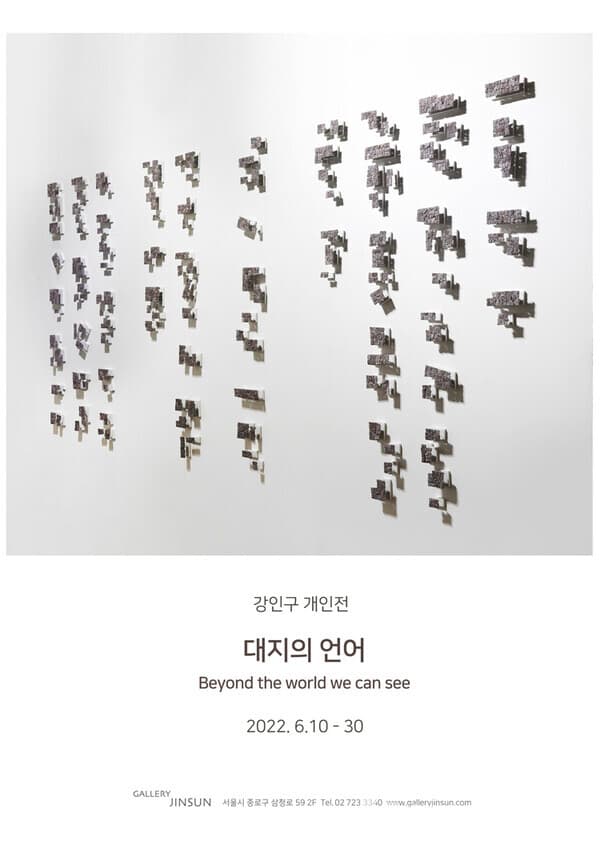
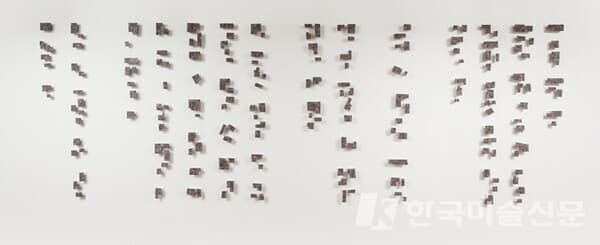
강인구 작가 개인전 '대지의 언어'展이 6월 10일부터 30일까지 삼청동 갤러리 진선에서 열린다.
강인구 작가는 생명의 울림을 조형적으로 변환해 표현한다. 강 작가는 "시간과 공간에 한정된 인간 존재는 자연의 법칙에 따라 살아가지만 유한성이라는 한계를 벗어날 수 없는 존재며 물리적으로 한정된 존재자인 인간은 정신적 사유를 통해 그 한계를 넘어서기를 갈구한다."라며 "그러한 욕망은 인간의 문명으로 또 다양한 사회적 형식으로 나타나는데 그중의 하나가 바로 예술"이라고 설명한다.
강 작가의 작업 역시 그러한 열망의 한 구절이며 인간의 유한성을 예술을 통해 승화시킨다. 그의 작업은 단순히 문장의 수사로 예술을 머물게 하는 것이 아니라, 보다 포괄적인 방식으로 우리의 삶과 존재를 탐구한다.
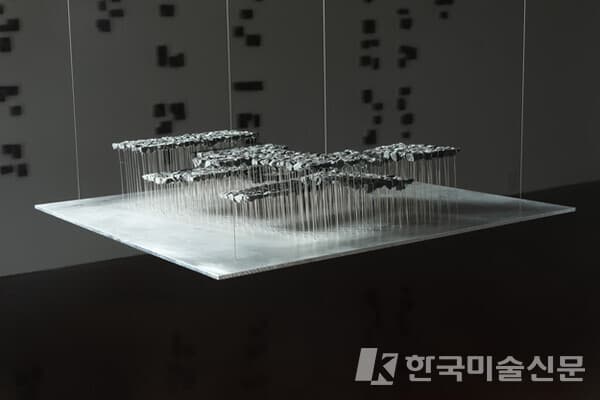
강 작가의 작업은 주로 돌로 이루어지고 있는데 여기서 중심이 되는 것은 강한 생명력의 에너지이다. 바닥 위에 조금씩 띄워진 돌들과 평면에 부착된 돌들은 미세하지만 항상 움직이는 느낌을 준다. 특히 관람자가 설치된 돌들 사이를 지나가거나, 평면에 부착된 돌들에 빛이나 조명이 드리워지면 미세한 진동이 나타난다. 마치 불어오는 바람에 숲의 나무들이 조금씩의 흔들리는 것처럼 그 돌들은 우리와 만날 때 항상 진동한다. 강 작가에게 그러한 진동은 살아있다는 울림이며 세상에 던져진 우리의 울부짖음이다. 비록 우리의 운명이 몰락으로 향할지라도 그 울림은 끊어지지 않고 계속 이어지는 것이다.
강 작가의 작업은 설치가 중심인데, 그의 설치 작업은 주관-객관 사이의 ‘긴장’에서 나타나는 재현의 문제에 몰두하기보다는, 주관과 객관이 함께 작용하는 ‘지향성’이라는 개념을 통해 상황을 사유하는 방식이다. 그런데 이러한 사유는 ‘세계와 나’와의 관계가 명확하지 않고 불안정하다는 것을 전제로 한다.
현대사회의 분열과 혼돈은 특정한 개념으로 설명할 수는 없다. 세계는 더 이상 고정되어 있지 않고 분열된 세계를 인식할 수 있는 ‘나’라는 개념조차도 희미해진다. 그래서 강 작가의 작업은 불특정한 나와 분열의 세계가 함께할 수 있는 장소를 만드는 것으로, 그러한 ‘장소성’에서 삶과 예술의 본질을 파악한다.
그의 이러한 작업은 ‘세계에 대한 인식의 실패’라는 전제에서 출발하기 때문에 불안하고 모호하다. 현대미술은 그러한 모호함과 불안감을 통해 새로운 조형적 방식을 모색했다. 그러나 강 작가의 작업은 그러한 불안과 모호성을 강조하기보다는, 자연의 생명력 특히 자연의 울림이라는 개념을 통해 그러한 불안감을 해소시키려 한다.
<바위, 바다를 만나다(2017)>와 <일어서다(2015)> 같은 작품들은 분리와 응집이라는 역동성을 함께 보여준다. 벗어나지만 돌아오고자 하는 욕망들, 돌아오지만 다시 벗어나고자 하는 몸부림이 진동을 통해 우리에게 전달된다. 이러한 구심력과 원심력은 우리의 삶의 여정에서는 항상 반복되는 요소이다. 그런데 그러한 반복의 울림이 멈추면 우리는 존재를 망각하게 되고 우리는 삶의 지형도를 잃는다. 그래서 강 작가의 작업은 그러한 중단없는 울림을 지속하게 해준다.
강 작가의 진동과 울림은 자연과 예술을 분리하는 것이 아니라 재구성하는 것으로, 자연이 가진 생명력을 토대로 세계에 새로운 ‘구조와 형식’을 부여하는 것이다. 이러한 재구성은 근원적인 생명력인 울림을 통해 가능해진다. 숙명적인 자연의 법칙을 거부할 수는 없지만 자연이 가진 생명력이라는 울림을 받아들이면서 인간 존재의 한계를 벗어나려는 상황이 만들어지는 것이다. 따라서 공간을 부유하는 강 작가의 작업은, 어쩔 수 없는 추락의 운명을 지니지만 그래도 허공으로 솟구치고자 하는 ‘능동적 추락’을 지속하는데, 바로 이것이 ‘중력의 거부’이다.
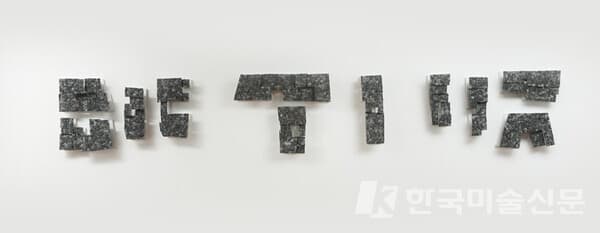
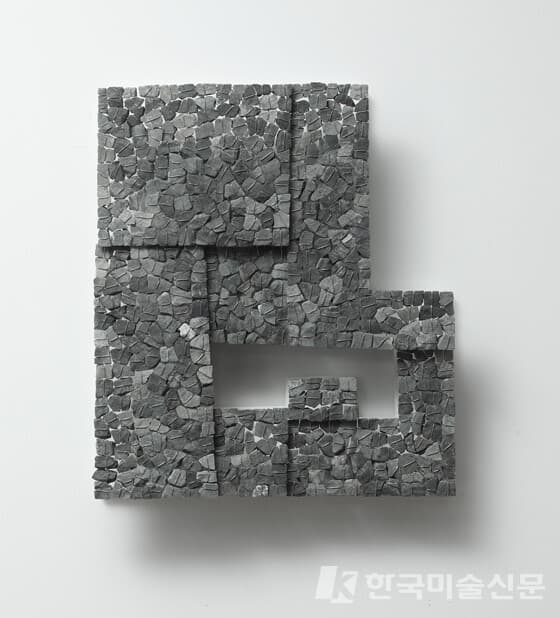
‘중력의 거부’는 2010년대부터 설치와 병행된 평면작업에서도 나타난다. 이 당시의 평면작업들 역시 세계의 재구성이라는 과정으로 진행된다. 화면 위에 철사로 고정된 조그만 돌들은 일정한 공간을 두고 평면에 부착된 형태인데, 조금씩의 높낮이가 다른 돌들의 형태는 멀리서 보면 마치 바위가 갈라진 형태처럼 보인다.
오랜 세월 자연의 풍파를 견딘 바위에는 무수히 많은 선이 각인되어 있다. 그러한 선들에는 세월의 무게뿐만 아니라 스스로 존재하기 위해 견딘 바위의 강인한 생명력도 표현되어 있다. 강 작가의 평면 위에 늘어진 돌들은 바로 그러한 인고의 세월을 견딘 강한 생명력을 상징한다. 이러한 방식은 설치작업에서 나타났던 진동의 울림이 시각적으로 형상화된 것이다.
최근 몇 년간의 평면작업은 기존의 작업에 비해 좀 더 부드럽고 자연스러운 방식으로 패턴화되고 있다. 즉 무거운 삶의 중심에서 벗어나 주변부의 삶과 다양한 상황과 사태를 한 걸음 떨어져서 조망하려고 한다. 마치 언덕 위에서 먼 들판을 바라보듯, 또 작가의 말처럼 인공위성에서 지구를 바라보는 듯한 무심한 응시가 그것이다.
“구글 어스(goole earth)는 나에게 지구를 평면으로 보여주고 나는 지구가 평면이라는 착각을 가끔 하기도 하고 나에게 공기를 가르는듯한 자유를 제공한다.” - 강인구 작가노트 중
강 작가는 최근의 평면작업을 통해 물리적 중력뿐만 아니라 사회적, 예술적 중력에서도 벗어나려 한다. 부단한 자기부정과 치열한 자기성찰은 일단 접어두고, 또 예술형식의 정형화된 재현의 언어도 벗어나 명징한 이미지들로 화면 공간을 채워나간다. 여기서 나타나는 것은 조망 내지 무심한 응시를 통한 새로운 조형 어법의 모색이다.
위에서 아래로 내려다보며 조망의 형태는 형식적인 측면에서 두 가지로 나타난다. 첫째는 정적인 세계로 선과 면으로 구성된 세계이다. 질서정연한 사각의 형태들은 다양한 패턴으로 서로 뭉쳤다가 흩어지면서 일종의 지형도를 만들어 낸다. 두 번째는 그러한 형태들이 평면 위에 재배치되면서 일정한 동작과 리듬이 발생한다. 이것들은 동적인 이미지로 형상들이 고정되어 있지 않고, 일종의 리듬에 따라 뭉쳤다고 흩어지고 하는 자유로운 노마드의 형식을 취한다. 그러한 자유로움에서 새로운 이미지가 형성되는데 그것이 바로 문자 이미지인 것이다.
새롭게 형성된 문자 이미지들은 특정한 실재하는 언어가 아니다. 어디서 본 듯하지만 결코 우리가 본적이 없는 문자의 형태들이다. 이것은 그가 기존의 언어를 숨기고 있는 새로운 언어로 세상을 조망한다는 것을 의미한다. 즉 기존의 설치에서는 삶에 대한 해석과 그 의미의 중요성이 강조되었다면, 최근의 평면작업은 무엇을 의미한다는 것보다 무엇을 보여준다는데 중점을 두고 있는 것이다.
이질적인 문자와 문장의 형태들은 어떠한 형식적인 목적성보다는 내면적 공감을 바탕으로 이루어진다. 시작과 끝이 없는 문장들은 음악의 리듬처럼 무용의 몸짓처럼 그저 허공을 맴돌뿐이다. 보여줌을 통해 나타나는 세계는 사유되지 않는 것을 사유하는 세계이다.
강 작가의 울림의 조망은 기존의 습관화된 감각과는 다른 감각을 촉발하는 것이고, 내가 가지고 있지 않은 것, 유연한 것들을 볼 수 있는 시선이다. 그리고 그러한 시선에서 우리는 우리에게는 하찮은 것들로 치부되어 잊혀져간 흔적들을 찾을 수 있는 것이다.
Kang In-koo's work is made through a process in which the resonance of life is formally transformed. Bound by time and space, human beings live in compliance with the laws of nature. We cannot escape the limits of our finite nature, but long to transcend them through thought. This desire is manifest in human civilization and in various social forms, and one of them is art.
Kang’s work is also a passage of such aspiration, as he seeks to transcend the finite nature of humanity through art. However, his work does not simply allow art to remain as a rhetoric of sentences, but rather explores our lives and existence in a more comprehensive way.
His works mainly use stones, and the core element here is the energy of strong vitality. The stones, some slightly distanced from each other on the floor, some attached to a separate flat surface, always offer a feeling of subtle movement. In particular, when the viewer passes between the installed stones or when lighting is applied to the stones mounted on the flat surface, slight vibrations occur. Just as trees in a forest move little by little when the wind blows, the stones always vibrate when they meet us. To the artist, such vibrations are the resonance of being alive, and the cries of us who are thrown into the world. Even if our destiny is headed for a downfall, this resonance continues, without interruption.
In Kang In-koo’s work, the essential element is installation, and his installation process is a way of thinking about situations through the concept of 'directivity,' in which subjectivity and objectivity work together, rather than focusing on the problem of representation that emerges in the 'tension' between subjectivity and objectivity. However, this way of thinking presupposes that the relationship between ‘the world and me’ is not clear, and is unstable.
The segmentation and chaos of modern society cannot be explained by any specific concept. The world is no longer fixed, and even the concept of an ‘I’ that can perceive the segmented world is blurred. Therefore, Kang's work seeks to create a place where the unspecified ‘me’ and the divided world can coexist, and to grasp the essence of life and art from such ‘placeness.’
However, these works are unstable and ambiguous because they start from the premise of ‘a failure to perceive the world.’ Contemporary art seeks a new formal method through such ambiguity and anxiety. Yet Kang's work does not emphasize this anxiety and ambiguity, and instead tries to resolve the anxiety through the concept of the vitality of nature, especially its resonance.
Works such as “A Rock Meets the Sea (2017)” and “Stand Up (2015)” show the dynamism of separation and cohesion at the same time. The desire to escape but to return, the struggle to come back but to escape again, is communicated to us through vibration. These centripetal and centrifugal forces are elements that are always repeated in our life journeys. However, when the resonance of such repetition stops, we forget our existence and lose the topography of life. His works allow such an uninterrupted resonance to continue.
Kang's vibration and resonance do not separate but reconstruct nature and art, and give a new 'structure and form' to the world based on the vitality of nature. This reconstruction is made possible through the fundamental vitality, the resonance. It is impossible to reject the laws of nature; however, accepting the resonance of nature’s vitality leads to a situation in which we can try to transcend the limits of human existence. While Kang's works that are floating in space have an unavoidable fate of falling, they still continue the 'active fall' in which he wants to soar into the air, which is the 'rejection of gravity.'
'Rejection of gravity' is also shown in his flat surface work, which Kang does himself during the installation, a process he has used since the 2010s . The flat surface works of that time were also done in the process of a reconstruction of the world . Small stones fixed with wires on the screen are attached to a flat surface with a certain space between the stones, and the stones of different heights look like cracked rocks from a distance.
Innumerable lines are engraved on the rocks that have withstood the winds and waves of nature for many years. Such lines express not just the weight of time, but the strong vitality of the rocks that have endured to exist on their own. The stones that hang on this flat surface symbolize the strong vitality that has endured such hardships. In this way, the resonance of vibrations that appear in the installation work is visualized.
In recent years, the flat surface works have been patterned in a softer and more natural way compared to existing works. In other words, Kang has tried to get away from the center of life, and look at the life of the periphery and various situations from a step away. It is an indifferent stare, as if you are looking at a distant field from a hill or looking at the earth from an artificial satellite, as the artist himself described it:
“Google Earth shows me the Earth as the flat surface, and I sometimes think that the Earth is actually flat. This gives me a sense of freedom, as if I am flying through the air.”
Through his recent flat surface work, Kang In-koo tries to escape not just physical gravity, but social and artistic gravity as well. Constant self-denial and fierce introspection are put aside, and the artist breaks away from the standardized representation of art forms. He then fills the space with clear images. What appears here is the search for a new formal language through a perspective, or an indifferent gaze.
As you look down from the top, the form you see appears in two ways. The first is a static world, which is the world composed of lines and flat surfaces. The orderly square shapes form a kind of topographical map by clustering together in various patterns and then scattering. Second, as those shapes are rearranged on a flat surface, certain movements and rhythms occur. These are dynamic images, and the figures are not fixed but take the form of a free nomad that are grouped together based on some sort of rhythm. A new image is formed from such freedom, and that is the text image.
The newly formed text images do not use specific, real languages. They show the forms of letters we may have seen somewhere but have never actually seen before. This means that he sees the world with a new language that hides the existing language. In other words, if the artist’s previous installations emphasized an interpretation of life and the importance of its meaning, his recent flat surface works focus on what is shown rather than what it means.
The heterogeneous character and sentence forms are based on inner empathy rather than any formal purpose. Sentences without a beginning or end simply hover in the air, like a rhythm from a piece of music or a movement from a dance. The world revealed through showing is a world that thinks about the unthinking.
His vision of resonance triggers a different sense from the habitual, and is a gaze that allows us to see things that we do not have and are flexible. From such perspective, we can find traces that we may have forgotten, or overlooked as insignificant.