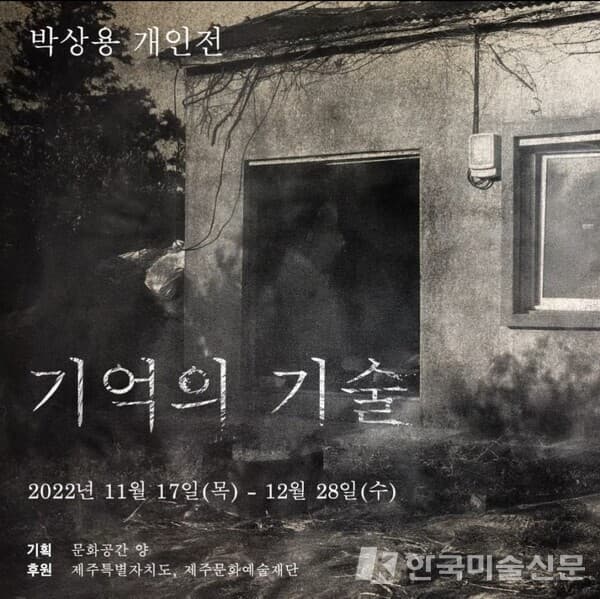
여기 재로 만들어진 사진 이미지가 있다. 모든 것이 불에 타버리고 난 후에도 남아있는 재와 같이 모든 의미가 소진된 후에도 여전히 남아있는 흔적의 이미지다. 베일에 싸인 것처럼 흐릿한 흑백사진 속에서 잿빛 형상들이 드러난다. 재라는 흔적은 현전하지 않지만 동시에 부재도 아닌 채로 존재한다. 흔적은 좀처럼 의식되거나 자각되지 않고, 표상하거나 언표할 수도 없지만, 의미화할 수 없는 것이 존재한다는 것을 증거한다. 진실 그 자체로 드러날 수 없어 허구의 옷을 입는 것처럼 흩어져버린 재들은 사진이라는 매개를 통해 이미지로서 나타난다. 재로 만든 사진은 아무것도 재현하지 않으면서 여전히 다른 의미로 채워질 빈 공간으로 남아 있다. 그 공간은 아무것도 드러내지 않는 동시에 시제가 얽힌 시공간이 남기고 있는 무언가를 드러내며, 현재가 기억할 수 없는 과거를 소환한다.
박상용의 풍경 사진을 보면 처음 본 곳이지만 어디선가 본 듯하고, 이미 봤던 것을 다시 보는 것 같은 기시감이 느껴진다. 낯설면서도 익숙한 장소가 비밀을 숨기고 있는 듯하다. 스펙터클한 광경이나 상징적인 기념물은 없지만, 그 공간이 품고 있는 거대한 역사가 사진 속의 겹쳐진 시공간에 켜켜이 담겨있다. 이번 전시에서 작가는 제주도 거로 마을의 풍경을 담담히 보여준다. 지금은 거의 사라지고 없는 옛 불턱에 검은 현무암과 대조를 이루는 하얀 재가 바닥에 흩어져 있다. 움막 같기도 하고 오름 같기도 하다가 무덤 같기도 한 장작더미 사이로 피어오르는 연기가 거세지고, 어느새 불씨는 보이는 것을 모두 재로 만든다. 빛이 스며들어 있는 담벼락, 성벽이 있던 자리, 무심한 시선을 보내는 검은 개, 마을을 거닐며 찍은 풍경들은 마을 사람들이 겪어낸 수많은 이야기들을 보여주지 않는다. 하지만 사진으로 재현된 풍경은 우리가 모르는 시공간으로 우리를 안내한다.
박상용의 흑백사진은 장소 특정적이거나 특정 시제가 없다. 제주도의 거로 마을을 중심으로 찍은 사진들이지만 제주라고 특징지을만한 단서나 정보가 거의 없으며 오히려 우리가 익히 아는 제주의 모습이 아닌 것 같다. 그러나 동시에 사진 속 공간의 과거와 현재, 도래할 미래의 모든 이미지가 관통된 느낌이다. 오래전에 이미 돌이킬 수 없이 흘러가 버린 순간들과 과거에 실현되지 못한 틈으로 존재했다가 다시 되돌아오는 미래가 깃들어있는 장소를 지금 여기 바라보고 있는 나를 발견하게 된다. 사진 속 시제가 뒤섞인 공간에서 내가 실제로 겪어보지 못한 과거의 기억들이 되살아난다. 사진이라는 흔적에 남아있는 눈에 보이지 않는 자국들은 현재에는 사라지고 없지만 부재하는 것의 현전을 나타내는 징표이다. 실제 공간에서는 보이지 않은 채 망각되거나 은폐되어 있던 것들이 사진 이미지를 통해 볼 때 과거의 시공간을 상상할 수 있게 하고 예측할 수 없는 미래의 기억을 가능하게 한다. 사진을 통해서 실제 현실에서는 할 수 없었던 다른 미적 경험을 할 수 있게 되는 것이다.
필름 카메라로 일상의 풍경을 촬영한 후 사진을 현상하고 인화하는 전 과정은 작가에게 하나의 수행적인 과정이 되고, 그 과정 자체가 작업의 주제가 된다. 박상용은 까다롭고 섬세하게 이뤄지는 과정을 반복하면서 자신만의 퍼포먼스를 선보이며, 작가의 의도와 우연의 효과가 결합되어 만든 작은 차이들을 세심하게 관찰한다. 이번 전시에서는 비은염 사진 인화 방식인 검오일기법(Gum oil ash print)을 통해 재를 표면에 붙이는 실험을 했다. 19세기에 처음 개발된 검프린트는 감광물질을 만들어서 물감과 고무, 칼륨을 섞어 종이에 바르고 말리는 과정에서 거친 붓터치의 느낌을 줄 수 있어 회화적인 사진을 만들기 위한 탁월한 방식이었다. 박상용의 검오일기법은 형식과 내용적인 측면에서 모두 기존의 검프린트 방식과는 다른 면이 있다. 재를 표면에 안착시키기 위해 오일을 사용하며, 붓 자국이나 흐리기 기법 등의 인위적인 터치를 최소화한다. 그의 비은염 사진은 회화적인 이미지를 만들려는 목적이라기보다는 복잡한 제작 과정을 통해 드러나는 이미지 세계에 개입하는 작가만의 방식이다.
길고 느린 리듬으로 이어가는 인화 과정에서 여러 개의 층위가 빈 공간에 채워졌다 지워지기를 반복하면서 겹쳐진다. 과정은 언제나 불안정하다. 손의 감각, 압력, 속도, 머무는 시간이 맞아야 이미지가 균일하게 나온다. 그 과정에서 무수한 변주의 가능성이 존재한다. 매번 다른 반복 속에서 섬세하게 다듬어 나가 최종적인 이미지를 만들어낸다. 여기서 재는 가장 예측 불가능한 변수이면서, 색과 질감을 만드는 중요한 요소이다. 재는 균일하지 않은 입자 크기로 인해 불균형하고 거친 느낌의 촉각적인 이미지를 만드는가 하면, 사진 이미지의 색을 결정한다. 나무 잎사귀를 태워 나온 하얀 재를 사용할 때와 불완전 연소된 검은 재를 사용할 때의 색이 완전히 다르며 같은 재를 사용할 때조차도 미묘한 톤의 차이가 발생하기도 한다. 다른 한편으로 재는 아이러니하게도 분자적으로는 가장 안정된 상태이다. 다른 화합물과 이미 결합한 비교적 안정적인 상태이므로 다시 불이 붙지도 않고, 더 이상 태울 수도 없다. 재는 모든 것이 타고 남은, 지울 수도 없고, 제거할 수 없는 나머지이다. 재를 이용한 비은염 제작 과정은 사진의 명확하고 매끈한 이미지를 일그러뜨리고 재형성시킨다. 재라는 흔적은 현존과 부재 사이의 지속적인 미끄러짐이다. 모든 것이 다 탔기 때문에 현전하는 것은 아무것도 없지만, 재가 남아있기 때문에 부재하는 것도 아니다. 재는 부재의 표시이지만, 이 부재의 표시가 없다면 부재와 상실조차 우리는 알 수 없다. 사진 이미지는 불에 타버렸지만 모든 것이 소진되고 난 후에도 여전히 남아있는 재를, 세월이 흐르고 파괴와 재건이 몇 번씩 오갔는지 모를 장소에서도 살아남아 의미로 환원될 수 없는 잔존물을 불러낸다. 글. 황선영 (미학) (출처=문화공간 양)
Here is a photographic image made of ashes. It is an image of traces that remain even after all meaning is exhausted, like ashes that remain after everything has been burned. As if wrapped in a veil, gray figures are revealed in the blurry black-and-white photos. Traces of ashes are not present, but at the same time exist without being absent. Traces are seldom conscious or aware, cannot be represented or articulated, but testify to the existence of something that cannot be signified. The ashes scattered as if wearing fictional clothes because the truth itself cannot be revealed appear as images through the medium of photography. A photograph made of ashes remains an empty space to be filled with other meanings without reproducing anything. The space does not reveal anything, but at the same time, it reveals something left behind by the entangled time and space, and summons the past that the present cannot remember.
Looking at Park Sang-yong's landscape photos, it's the first place I've seen, but I feel like I've seen it somewhere, and I feel a sense of déjà vu as if I'm seeing something I've already seen again. An unfamiliar yet familiar place seems to be hiding a secret. There are no spectacular sights or symbolic monuments, but the huge history of the space is layered layer by layer in the overlapping time and space in the photo. In this exhibition, the artist calmly shows the landscape of Georo Village in Jeju Island. White ash, which contrasts with the black basalt, is scattered on the floor of the old bulteok, which is now almost gone. The smoke that rises between the piles of firewood, which look like a hut, look like an oreum, and look like a grave, intensifies, and before you know it, the embers turn everything in sight to ashes. The wall soaked with light, the place where the wall used to be, the black dog looking indifferently, and the scenery taken while walking through the village do not show the many stories the villagers have experienced. However, the landscape reproduced by photography guides us to unknown time and space.
Park Sang-yong's black-and-white photographs do not have a site-specific or specific tense. These are photos taken mainly of villages in Jeju Island, but there are few clues or information to characterize them as Jeju Island, and rather, they do not seem to be the Jeju we are familiar with. However, at the same time, it feels like all the images of the past, present, and future of the space in the photo are penetrated. I find myself looking here and now at a place where the moments that have already passed irrevocably a long time ago and the future that existed as an unrealized gap in the past dwells and then returns again. Memories of the past that I have never experienced in real life are revived in a space where the tenses in the photos are mixed. The invisible traces left in the traces of photography are now disappearing, but they are signs of the presence of what is absent. Things that were oblivious or concealed in real space make it possible to imagine the time and space of the past and to remember the unpredictable future when viewed through photographic images. Through photography, it is possible to have a different aesthetic experience that could not be done in real life.
The entire process of photographing everyday scenes with a film camera, developing and printing the photos becomes a performative process for the artist, and the process itself becomes the subject of the work. Park Sang-yong presents his own performance while repeating the complicated and delicate process, carefully observing the small differences created by the combination of the artist's intention and the effect of chance. In this exhibition, we experimented with attaching ash to the surface through gum oil ash print, a non-silver salt photo printing method. Gumprint, which was first developed in the 19th century, was an excellent method for creating pictorial photos as it could give the impression of a rough brush touch in the process of mixing paint, rubber, and potassium by making a photosensitive material, applying it to paper, and drying it. Park Sang-yong's gum-oil technique is different from the existing gum-print method in terms of form and content. Oil is used to settle the ashes on the surface, and artificial touches such as brush marks or blurring techniques are minimized. His non-silver salt photography is not the purpose of creating pictorial images, but rather the artist's own method of intervening in the world of images revealed through a complicated production process.
During the printing process, which continues in a long and slow rhythm, several layers are overlapped by repeatedly filling in and erasing empty spaces. The process is always unstable. The image comes out uniformly only when the feeling of the hand, pressure, speed, and staying time are right. There are countless possibilities of variation in the process. Each time, in different iterations, it is delicately refined to create the final image. Here, ashes are the most unpredictable variable and an important factor in creating color and texture. Ash creates a tactile image with an uneven and rough feeling due to the non-uniform particle size, and determines the color of the photographic image. The color is completely different when using white ash from burned tree leaves and when using black ash from incomplete combustion, and even subtle differences in tone occur when using the same ash. On the other hand, ironically, ash is the most stable state molecularly. Since it is in a relatively stable state already combined with other compounds, it does not catch fire again and cannot burn any more. Ashes are the remains of everything burned, indelible and irremovable. The process of making silver salt using ash distorts and reforms the clear and smooth image of the photograph. The trace of ashes is a continuous slip between presence and absence. Nothing is present because everything is burnt, but neither is it absent because the ashes remain. Ashes are a sign of absence, but without this sign of absence we cannot know even the absence and loss. The photographic image summons the ashes that have been burnt but still remain after everything has been exhausted, the remnant that cannot be reduced to meaning by surviving in an unknown place where time has passed and how many times it has been destroyed and rebuilt.
<편집자 주 : 미술평론은 독자들에게 미술 작품 이해도를 높이고 정보 전달을 위해 비상업적인 목적으로 제공하며 저작권은 평론가에게 있습니다>