근대 이전까지 미술의 주제는 대부분 종교화가 주류를 이루었고, 성전을 장식하거나 포교를 위해서 경전의 이야기를 작품의 모티브로 삼았다. 그래서 일반인과 다른 성인들의 거룩한 모습을 도상을 통해 구분하거나 그들의 일화를 미화하여 표현했다. 그런데 과연 이런 종교적 도상이나 일화로 사랑이나 자비 같은 종교의 본질을 표현할 수 있을까? 기독교 내부에서 한때 성상 파괴령이 내려진 것은 자칫 성상이 본질을 왜곡하는 우상이 될 우려가 있기 때문이다.
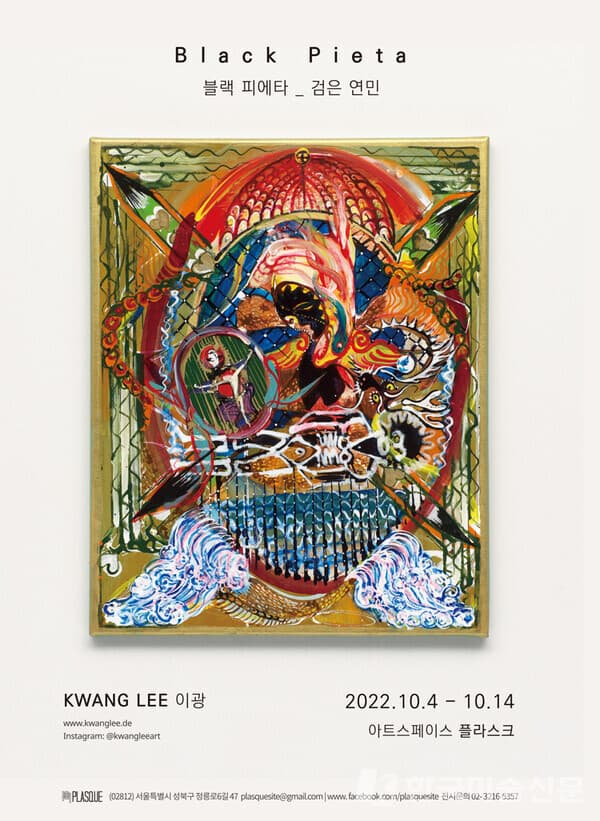
현대 작가들은 미술의 자율성을 명분으로 작품의 주제를 사회 현실이나 자신의 내면으로 전환함으로써 종교에 봉사해 온 종교화의 전통에서 벗어나고자 했다. 그러나 베를린에 거주하며 활동하고 있는 이광의 작품은 기독교의 오랜 주제인 <피에타>를 통해 종교화의 전통을 현대적으로 계승하고 있다는 점에서 주목된다. 그녀의 종교화는 기독교의 교리를 전하기 위한 도구가 아니라 자신의 종교적 감정을 감각적으로 끌어내고 있다는 점에서 신표현주의적인 특징을 보여준다.
그녀가 추구하는 종교적 감정이란 나와 남의 구분이 사라진 상태에서 가능한 사랑과 용서, 그리고 약자에 대한 연민 같은 인간 본연의 마음이다. 그녀가 이러한 종교적 감정을 예술의 주제로 삼게 된 것은 운명적으로 대학 시절에 경험한 인도 여행에서 비롯된 듯하다. 인도에서 그녀는 길을 잃고 우연히 빈민촌에 들어가게 되었는데, 그곳에서 길바닥에 시체처럼 누워 죽어가는 사람들의 장면을 목격하고 큰 충격을 받은 경험이 있다. 그리고 인도에서 힌두의 신들과 붓다의 유적지들을 돌아보면서 그녀는 인간의 고통과 종교의 본질에 대해서 깊은 생각을 하게 되었다.
그 이후로 그녀는 지배자들에게 착취당하며 미천하게 살아가는 흑인 노동자들이나 고향을 떠나 정처 없이 떠도는 난민들, 그리고 가난과 질병에 시달리는 사회적 약자들에게 남다른 연민을 갖게 되었다. 이 같은 연민은 자신의 불행했던 가족사와 무관하지 않아 보인다. 그녀는 폭력적인 아버지 밑에서 평생을 노동자로 생계를 꾸려온 어머니에 대해 깊은 연민을 느껴왔다. 불행한 가족사에서 비롯된 극심한 심리적 고통에서 그녀는 사랑과 용서를 통해 비로소 마음의 평안과 자유를 얻을 수 있었고, 이를 작품의 주제로 삼게 된 것이다.
이 같은 배경은 유대인 학살을 경험하고 고통받는 타자의 문제를 철학의 주제로 삼은 프랑스의 유대인 철학자 레비나스를 떠올리게 한다. 그는 고통받는 사회적 약자에게서 신의 얼굴을 발견하고, 연민의 마음으로 고통받는 타자를 향해 ‘나’를 넘어서는 것이 윤리의 시작이라고 주장했다. 레비나스가 고통받는 타자의 얼굴에서 신의 모습을 발견하듯이, 이광은 착취당하는 아프리카 흑인을 피에타의 주제인 성스러운 마리아와 예수로 대체하였다. 여기에 꿈틀대는 용의 꼬리나 반인반수 같은 자신의 무의식적 환상을 가미했다.
고통과 환희, 죽음과 부활, 의식과 무의식이 공존하는 이러한 작품은 고구려 벽화처럼 신명나는 열기와 에너지로 충만하다. 이러한 작품에서 주목되는 건 어떤 종교적 일화가 아니라 고통과 상처받은 마음을 정화하고 치유하는 강렬한 에너지다. 그녀는 마치 굿을 하는 샤먼처럼 사회의 폭력성과 살기를 자기 안으로 끌어들여 그것을 정화하고 치유한다. 이러한 이광의 작업은 마음에 응어리진 한과 트라우마를 풀어내어 치유하는 살풀이춤과 같은 메커니즘이라는 점에서 한국의 뿌리 깊은 샤머니즘의 전통과 맥을 같이한다. 글. 최광진 미술평론가
Until the modern era, most of the subjects of art were religious paintings, and stories in the scriptures were used as motifs for decoration of temples or propagation. Therefore, the holy figures of ordinary people and other saints were distinguished through icons or their anecdotes were glorified and expressed. But can such religious icons and anecdotes express the essence of religion, such as love and mercy? The reason why an order to destroy icons was once issued within Christianity is because there is a risk that an icon could become an idol that distorts its essence.
Modern artists have tried to break away from the tradition of religious paintings that have served religion by shifting the theme of their work to social reality or their inner self in the name of art autonomy. However, Kwang Lee's work, which lives and works in Berlin, draws attention in that it inherits the tradition of religious painting in a modern way through <Pieta>, a long-standing Christian theme. Her religious paintings show the characteristics of neo-expressionism in that they are not tools for conveying Christian doctrine, but sensuously eliciting her own religious feelings.
The religious feelings she pursues are human nature, such as love, forgiveness, and compassion for the weak, which are possible in a state where the distinction between me and others has disappeared. It seems that her decision to make religious feelings the subject of her art stemmed from a fateful trip to India she experienced while in college. In India, she lost her way and happened to enter a slum, where she was shocked to see people dying like corpses lying on the street. And while looking around the remains of Hindu gods and Buddhas in India, she came to think deeply about human suffering and the nature of religion.
Since then, she has developed extraordinary sympathy for black laborers who are exploited by the rulers and live in a humble way, refugees wandering aimlessly away from their hometowns, and the socially underprivileged suffering from poverty and disease. Such compassion seems to be related to her own unfortunate family history. She has felt deep compassion for her mother, who has made a living as a laborer all her life under an abusive father. She was finally able to gain peace of mind and freedom through love and forgiveness in the extreme psychological pain caused by her unfortunate family history, and made this the subject of her work.
This background reminds me of Levinas, a French Jewish philosopher who experienced the massacre and made the problem of suffering others the subject of philosophy. He argued that the beginning of ethics is to discover the face of God in the suffering socially underprivileged and go beyond 'me' towards the suffering others with a heart of compassion. Just as Levinas discovers the image of God in the face of the suffering other, Lee Kwang replaces exploited black Africans with the holy Mary and Jesus, the subjects of Pieta. Here, he added his own unconscious fantasies, such as a wriggling dragon's tail or half-man, half-beast.
These works, in which pain and joy, death and resurrection, consciousness and unconsciousness coexist, are filled with exhilarating heat and energy, just like the Goguryeo murals. What draws attention in these works is not some religious anecdote, but intense energy that purifies and heals pain and wounded hearts. Like a shaman performing an exorcism, she draws society's violence and murder into herself and purifies and heals them. Lee's work is in line with the deep-rooted tradition of shamanism in Korea in that it is a mechanism similar to the salpuri dance to release and heal deep-rooted resentment and trauma.