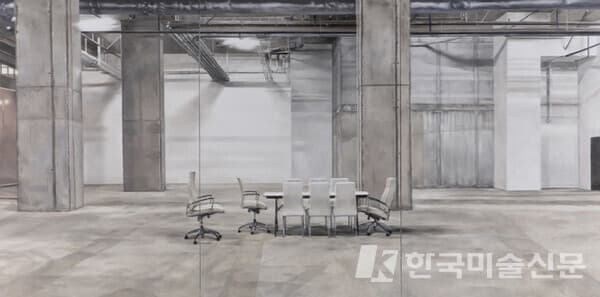
▲ 서완호, 그런다고 달라지는건 없겠지만Oil on Canvas, 193.9 x 390.9cm, 2022
발터 벤야민(Walter Benjamin)은 일찍이 사진 기술의 발명과 함께 예술이 가지는 원본의 '아우라(Aura)'가 사라진다고 말했다. 수공예 생산품으로서의 예술작품이 가지는 고유한 속성을 '아우라' 라는 개념을 통해서 설명한 벤야민의 이론은 매우 독창적인 것으로 주목받았다. 산업사회의 등장과 함께 상품은 기계를 통해 대량 생산되고 이미지는 복제가 가능해졌다. '아우라'의 의미적 기원은 '구름'이나 '흐림', '몽롱함'을 뜻하는 라틴어 'Nimbus'에서 왔다. 'Nimbus'는 예술을 설명할 때 사용했던 용어로 '신성한 빛'이나 '천사의 머리 위에 나타나는 빛'처럼, 신성하고 신비스러운 분위기를 표현할 때 썼다.
기술 복제 시대에 예술은 무한 복제될 수 있어 유일무이한 존재로서의 가치를 상실하게 될 뿐 아니라, 이미지로 존재하면서 다른 이미지 간에 유사성을 피하기 어려워진다. 그 때문에 자크 랑시에르(Jacques Ranciere)는 그의 책 『이미지의 운명(le destin des images)』에서 오늘날 예술가들에게 '닮지 않는 것'이 정언명령으로 받아들여지고 있다고 말했다. 그는 반면에 사진, 비디오, 일용품을 닮은 오브제의 전시가 갤러리와 미술관에서 추상화를 대체하고 있다고 비판했다. 그의 말대로 비-유사성이라는 엄격한 정언명령은 동시대 미술 내에서 그 자체로 특이한 변증법으로 작동하고 있다.
초기 서완호의 회화 작업을 살펴보면, 랑시에르가 말한 정언명령의 동시대적 변증법의 고민을 찾아볼 수가 있다. 작가는 미술사를 염두에 둔 거창한 주제나 스펙터클한 광경을 그리지 않았다. 대신에 그것들과 '닮지 않는 것'으로서 일상에서 만나는 오브제나 사람들의 모습 그리고 동네 골목의 풍경을 그렸다. 일상적이고 흔한 것이라고 해서 인터넷을 배회하는 어디에서나 볼 수 있는 아무런 의미 없는 그림을 그리는 것은 아니다. 분명 작가는 여기서 이 이미지들과 차별화된 정언명령을 수행하기 위해서 회화적 표현과 상황의 설명에 적절한 기술을 고민하고 있다. 사실 작가가 고민하는 기법이 그동안 미술사에서 닮은 작업을 찾기 어려울 만큼 고유한 것은 아니다. 하지만 어렴풋하게 공간 속으로 사라지는 이미지나 사물의 표면에 정교하게 달라붙지 않고 부유하는 붓질은 독창적인 관점에서 전통 산수화를 그리는 숙달된 준법에 비견할 만하다.
서완호는 작가 노트에서 '인간은 잊히지 않기 위해서 애쓰지만 자기 본능을 다 펼치기도 전에 사라진다.'라고 썼다. 이 말은 작가 스스로 동시대 미술 안에서 가지는 회의감과 불안을 동시에 포함한 말이기도 하다. 그래서 작가는 인간사회의 디스토피아적인 측면과 자기 내면에 자리하고 있는 고독과 불안을 그림을 통해서 들여다본다. 그래서인지 서완호의 화면은 흔들리고 뿌옇게 화면 속으로 흩어지며 등장인물들은 표현이 생략되거나 그리다가 만 화면처럼 정지된 상태로 남아 있다. 이 정지된 화면은 셔터 조리개와 스피드 조절에 실패한 피사체가 미처 카메라 렌즈를 통과해서 필름에 안착하기도 전에 날아가 버린 사진의 이미지처럼 찰나적이다. 발터 벤야민도 종교적 신성의 성격을 지니는 이 '아우라'는 찰나적으로 발현된다고 말했다. 같은 작품 속에서 매번 똑같이 '아우라'를 체험할 수 없다는 것을 의미하기도 한다. 아니, 서완호의 그림에 등장하는 인물들은 그림을 구상하는 단계에서부터 그 어떤 '아우라'도 부여받지 못한 존재로 등장한다. 그들은 화면에 존재하지만 존재하지 않는다. 당시에 그렸던 상당수의 작품에서 '이방인(Stranger)'이라는 제목을 찾아볼 수 있는 것도 같은 이유로 해석된다. 예의 작품에 등장하는 인물들은 그리스 신화에 등장하는 오르페우스(Orpheus)의 이야기에서처럼, 지하세계를 탈출해 이승의 빛을 보는 순간 뒤를 돌아보면서 사라져 버린 아내의 일화를 떠올리게 한다.
필립 뒤부아(Philippe Dubois)는 그의 책 『사진적 행위』에서 이 신화의 이야기를 인용하는데, 이승의 빛이 희미하게 될 때, 저승에서 돌아오던 오르페우스는 뒤를 돌아보지 말라는 금지를 어기고 뒤를 돌아보고 말았고, 그 순간 에우리디케는 지하세계의 어둠 속으로 사라져 버렸다. 바라보기 위해 정지한 순간은 곧 죽음의 순간이다. 셔터가 찰칵하고 이미지가 포착되는 순간 대상은 사라지고, 대상의 흔적만이 이미지로 영원히 고정된다. 이미지 속 대상은 이미 오래전부터 존재하지 않았다. 사진의 발명에 간여했던 나다르(Nadar)는 심령학에 바탕을 둔 '유령이론'을 통해서 자연계의 모든 신체는 일련의 유령들로 구성되고 이 유령들은 사방 모두 아주 얇은 막이 무한히 포개어진 잎 모양의 무수한 충돌로 이루어지며 눈은 이를 통해 신체를 인지한다고 봤다. 사진 촬영은 사진 찍는 대상의 여러 층 가운데 하나를 급습하여 떼어내 은판에 덧붙이는 것이기 때문에 신체를 구성하는 본질적 부분을 잃어버리는 것으로 이해했다. 사진을 많이 찍으면 영혼을 잃어버린다고 생각했던 원시적인 생각은 사진을 발명했던 나다르 자신에게서 연유된 것이다.
이런 우스꽝스러운 이야기와 무관하게 사진은 무언가 계속해서 죽음과 관계해왔다. 엄밀하게 말하면 카메라가 이미지를 발생시키는 순간은 언제든 죽어있다. 그것은 '아우라'가 죽어있거나 늘 새롭게 발현되는 것과 같은 이치다. 서완호의 그림에 등장하는 이미지들은 사진으로 포착된 이미지들에서부터 출발하기 때문에 유령처럼 화면 위를 배회한다. 그것은 심령학적 사진에서처럼, 매우 광학적 방식으로 재현된다. 좌우로 빠르게 움직이는 붓질을 통해서 피사체를 미처 따라가지 못하고 유령 신체의 껍질 일부를 놓쳐버린 사진처럼, 이미지들은 움직이는 붓질을 따라 사라지고 있다. 그 때문에 광경은 꿈처럼 낯설게 보인다.
그래서 서완호 그림 속의 대상은 “나는 죽어있다”라고 말한다. 이 그림들은 그래서 우리 모두를 불안하게 한다. 이 이미지들은 당신이 마주했던 어떤 한순간의 추억이었거나 아름다웠던 기억의 부재를 대신할 것이다. 모래사장에 발자국을 남기듯이 삶은 이렇게 '자국'을 남긴다. 에우리디케가 지하세계로 빠져서 들어가는 순간을 보는 오르페우스처럼 사랑하는 사람의 소거를 바라만 볼 수밖에 없다. 미술사가 로잘린드 크라우스(Rosalind Krauss)는 빅토르 위고(Victor-Marie Hugo)의 임종 초상 이외에 죽은 사람의 사진을 찍지 않았다는 나다르의 사진을 '자국'이라는 기호학적 위치에서 분석했다.
서완호의 작업이 좌우로 흐르는 컬러프린터의 에러 출력물 같은 형태로 그려지기 시작한 것은 붉은색으로 가득 찬 <동문사거리>(2017)와 <구시가지>(2017)에서다. 이 그림들에는 사람이 등장하지 않는다. 또 그림에서 명확한 색깔 띠를 확인할 수 없었다. 이 그림들은 일찍이 게르하르트 리히터(Gerhard Richter)가 대중잡지 <슈피겔>에 실린 적색 군단의 사진을 가지고 수행하던 작업을 떠오르게 한다. "나는 화면을 지운다. 그로 인해 그림이 예술가의 손 기능이 아니라 오히려 기술적으로 매끈하고 완벽하게 보이게 하기 위해서다."라고 말했던 리히터는 사진이 지시하는 사실로서의 이미지를 뭉개거나 변형시켜서 미스테리한 사진 회화에 도달했다. 이듬해에 그린 재개발구역>은 일상에서 마주치는 무심한 전봇대를 둘러싼 나무숲을 그려냈다. 이 작품에서 붓질은 일정한 간격으로 노란색이나 붉은색 혹은 초록색 등으로 나뉘어서 한 번은 좌측으로 다른 한 번은 우측으로 교차하면서 이동하고 있다.
이 작업은 흑백으로 그려진 풍경 88올림픽 마스코트 호돌이 동상이 어렴풋이 등장하는 <오래된 전설>(2019), 길고양이를 그린 <밤 손님>(2020), 횃불(2020) 등으로 이어진다. <국립공원National Park>(2020) 시리즈에 이르면 흑백 화면의 붓질은 불꽃처럼 흩어지거나 나다르의 상상에서처럼 심령학적 이미지로 전환된다. 이 그림들은 혼령의 숲이 발산하는 자연 신체가 화면으로 날아와 붙은 것처럼 기이하고 불길해 보인다. 풍경은 네거티브 사진이나 적외선 카메라를 사용해서 찍은 것처럼 다른 광학적 기술의 결과로 얻어진 것이다. 자연의 아름다움과 싱그러움을 시각적으로 확인할 수 없는 어두운 밤에 포착한 국립공원의 풍경이다.
서완호의 작업이 이처럼 독특한 형식을 띠게 된 것은 그림을 전체적으로 그리는 것이 아니라 위에서부터 차례로 한 줄씩 그리는 습관에서 비롯되었다. 사진을 정확하게 그려내기 위해서 고안된 이 방법은 마치 프린터의 카트리지가 좌우로 움직이면서 이미지를 뿌려대는 형국과 유사하다. 작가의 손이 오른쪽에서 왼쪽으로 이동할 때마다 한 줄의 이미지가 생겨나고 다시 왼쪽에서 오른쪽으로 이동할 때 다른 이미지 한 줄이 캔버스에 등장하는 것이다. 서완호는 리히터가 그러했던 것처럼 손 기능이 아니라 훨씬 더 기술적으로 매끈하고 완벽한 프린터를 재현하고 있다. 그래서 그림은 더욱 기술적으로 완벽해졌다. 이 그림들은 작업을 추가해 갈수록 프린터와 더 닮아 갔다. 잉크가 부족해서 발생하는 에러 현상까지 화면에 포착할 수 있게 되었다.
서완호가 팔복예술공장에 입주해서 그림 <그런다고 달라지는 건 없겠지만>(2021)은 가로 4미터 세로 2미터의 대형작업이다. 천정이 높은 공장의 풍경처럼 보이는 이 공간의 중앙에는 사무실 테이블과 의자 들 만 덩그러니 놓여 있다. 회색빛 콘크리트 공간을 말쑥하고 정교하게 그려낸 이 작품에서는 작가가 초기에 그렸던 일상의 풍경들에서 보았던 정교하고 회화적인 붓질을 다시 볼 수 있다. 이 그림에 부여된 제목 <그런다고 달라지는 건 없겠지만>의 어조처럼, 작가는 예의 프린터처럼 무심하게 그림을 좌에서 우로 반복해서 그려내려 왔다. 무엇이 작가의 그림을 이처럼 가능하게 하는 것일까? 기계를 연기했던 앤디 워흘(Andy Warhol)이나, <원시정령의 힘이 나에게 오른쪽 구석에 빨간 색을 칠하라고 명령한다>고 작품 제목을 붙였던 지그마 폴케(Sigmar Polke)를 소환하지 않더라도, 원하는 방식대로 버튼을 누르면 이미지를 출력해 낼 수 있는 작가의 재능에 관해 생각해 보지 않을 수 없다. 기계를 연기하거나 절체절명의 숙명을 펼치는 것 같은 미술 행위의 당위는 어디에서 오는 것일까? 그런다고 달라지는 건 없겠지만, 오늘도 묵묵히 이미지를 그려내는 미술 노동을 감내한다.
글. 백기영 큐레이터
Walter Benjamin said early on that with the invention of photography technology, the original 'aura' of art disappears. Benjamin's theory, which explained the unique properties of a work of art as a handicraft product through the concept of 'aura', drew attention as being very original. With the advent of industrial society, products are mass-produced through machines and images can be reproduced. The semantic origin of 'aura' came from the Latin word 'Nimbus', which means 'cloud', 'cloud' or 'dream'. 'Nimbus' is a term used to describe art, and was used to express a divine and mysterious atmosphere, such as 'divine light' or 'light appearing above an angel's head'.
In the era of technological reproduction, art can be reproduced infinitely, losing its value as a unique existence, and it becomes difficult to avoid similarities between different images while existing as images. For that reason, Jacques Ranciere said in his book Le destin des images that 'not being dissimilar' is accepted as a categorical imperative by today's artists. On the other hand, he criticized that exhibitions of objects resembling photographs, videos, and daily necessities are replacing abstract paintings in galleries and museums. As he said, the strict categorical imperative of non-similarity operates as a unique dialectic within contemporary art.
Looking at Seo Wan-ho's early paintings, we can find the contemplation of the contemporary dialectic of the categorical imperative that Rancière said. The artist did not paint grandiose subjects or spectacular scenes with art history in mind. Instead, as 'things that don't resemble' them, I painted objects and people I meet in everyday life and the scenery of the alleys in the neighborhood. Just because it's mundane and common doesn't mean painting meaningless pictures that can be found everywhere on the Internet. Clearly, the artist is contemplating appropriate techniques for pictorial expression and explanation of the situation in order to carry out the categorical imperative differentiated from these images here. In fact, the technique the artist contemplates is not so unique that it is difficult to find similar works in art history. However, images that vaguely disappear into space or brush strokes that float without elaborately adhering to the surface of objects are comparable to the mastery of traditional landscape painting from an original point of view.
Seo Wan-ho wrote in the artist's note, 'Human beings try hard not to be forgotten, but they disappear before they can fully develop their instincts.' These words also include the skepticism and anxiety that the artist himself has within contemporary art. So, the artist looks into the dystopian aspects of human society and the solitude and anxiety that resides inside him through his paintings. Perhaps because of this, Seo Wan-ho's screen shakes and blurs into the screen, and the characters' expressions are omitted or remain frozen as if they were drawn. This still screen is fleeting, like the image of a photograph in which the subject whose shutter aperture and speed have failed to pass through the camera lens and is blown away before settling on the film. Walter Benjamin also said that this 'aura', which has the character of religious divinity, is manifested momentarily. It also means that you cannot experience the same 'aura' every time in the same work. No, the characters in Seo Wan-ho's paintings appear as beings who are not endowed with any 'aura' from the stage of designing the painting. They exist on the screen, but they don't exist. It is also interpreted for the same reason that the title 'Stranger' can be found in many of the works he drew at the time. As in the story of Orpheus in Greek mythology, the characters appearing in Ye’s works recall the anecdote of his wife who escaped from the underworld and looked back the moment she saw the light of the world.
Philippe Dubois quotes the story of this myth in his book 『The Photographic Act』. At that moment, Eurydice disappeared into the darkness of the underworld. The moment you stop to look is the moment of death. The moment the shutter clicks and the image is captured, the object disappears, and only the traces of the object are permanently fixed as an image. The object in the image has not existed for a long time. Nadar, who was involved in the invention of photography, argued that through the 'ghost theory' based on psychics, all bodies in the natural world are composed of a series of ghosts, and these ghosts are infinitely superimposed leaf-shaped ghosts on all sides. It is made up of collisions, and the eye perceives the body through this. Photography is understood as losing an essential part that makes up the body because it is to raid and remove one of the many layers of the subject to be photographed and attach it to a silver plate. The primitive idea of losing one's soul by taking too many pictures originated from Nadar himself, the inventor of photography.
Regardless of this ridiculous story, photography has always had something to do with death. Strictly speaking, the moment the camera generates an image is always dead. It is the same reason that 'aura' is dead or always newly manifested. The images that appear in Seo Wan-ho's paintings start from images captured in photographs, so they wander over the screen like ghosts. It is reproduced in a very optical way, as in a psychic photograph. Like a photograph in which a part of the body of a ghost is missed without being able to follow the subject through brushstrokes moving left and right quickly, the images disappear along with the moving brushstrokes. Because of that, the sight seems strange, like a dream.
So, the subject in Seo Wan-ho's painting says, "I am dead." These pictures thus unsettle us all. These images will replace the absence of beautiful memories or memories of a moment you encountered. Just like leaving footprints on the sandy beach, life leaves 'marks' like this. Like Orpheus watching the moment Eurydice falls into the underworld, he has no choice but to watch the disappearance of his beloved. Art historian Rosalind Krauss analyzed Nadar's photographs, which said that he did not take pictures of the dead other than Victor-Marie Hugo's deathbed portrait, from the semiotic position of 'print'.
Seo Wan-ho's work began to be drawn in the form of error output from a color printer flowing left and right in <Dongmun Crossroads> (2017) and <Old Town> (2017) filled with red. No people appear in these paintings. Also, no clear color bands could be identified in the picture. These paintings are reminiscent of Gerhard Richter's earlier work with the Red Legion photos published in the popular magazine Der Spiegel. Richter, who said, “I erase the screen, so that the painting is not a function of the artist’s hand, but rather technically smooth and perfect,” said Richter, who reached a mysterious photographic painting by crushing or transforming the image as a fact indicated by the photograph. did. Redevelopment Area, drawn the following year, depicts a forest of trees surrounding an indifferent telephone pole encountered in daily life. In this work, the brushstrokes are divided into yellow, red, or green at regular intervals, crossing one to the left and the other to the right.
This work continues with <Old Legend> (2019), in which a statue of Hodori, the mascot of the 1988 Olympic Games, is vaguely depicted in black and white, <Night Guest> (2020), and Torch (2020), which depicts a stray cat. In the <National Park> (2020) series, the black and white brushstrokes are scattered like fireworks or converted into psychic images as in Nadar's imagination. These paintings look bizarre and ominous, as if a natural body emanating from the forest of spirits flew onto the screen and stuck to it. Landscapes are obtained as a result of other optical techniques, such as photographic negatives or taken using an infrared camera. This is the scenery of a national park captured on a dark night when the beauty and freshness of nature cannot be visually confirmed.
The reason Seo Wan-ho's work took on such a unique form stemmed from his habit of drawing one line at a time from the top rather than painting the whole picture. This method, designed to accurately draw a photo, is similar to a printer's cartridge moving left and right to spray images. Each time the artist's hand moves from right to left, a line of images is created, and when the hand moves from left to right again, another line of images appears on the canvas. Seo Wan-ho is reproducing a sleek and perfect printer far more technically than hand function, as Richter did. So the painting became more technically perfect. These drawings became more like printers as I added more work to them. Even errors caused by insufficient ink can be captured on the screen.
Seo Wan-ho moved into Palbok Art Factory, and the painting <Things Won't Change That> (2021) is a large-scale work measuring 4 meters wide and 2 meters long. In the center of this space, which looks like a factory landscape with a high ceiling, there are only office tables and chairs. In this work, which neatly and elaborately depicts a gray concrete space, you can see the sophisticated and painterly brush strokes seen in the daily scenes that the artist painted in his early days. Just like the tone of the title given to this painting, <Things Won't Change>, the artist has repeatedly painted from left to right, indifferently, like a printer. What makes the artist's paintings so possible? Even if you don't summon Andy Warhol, who played the machine, or Sigmar Polke, who titled his work <The power of the primal spirit commands me to paint the right corner red>, the way you want I can't help but think about the talent of the artist who can print out images with the press of a button. Where does the right to act in art, such as acting a machine or unfolding a desperate fate, come from? That won't change anything, but I endure the art labor of drawing images in silence today.