
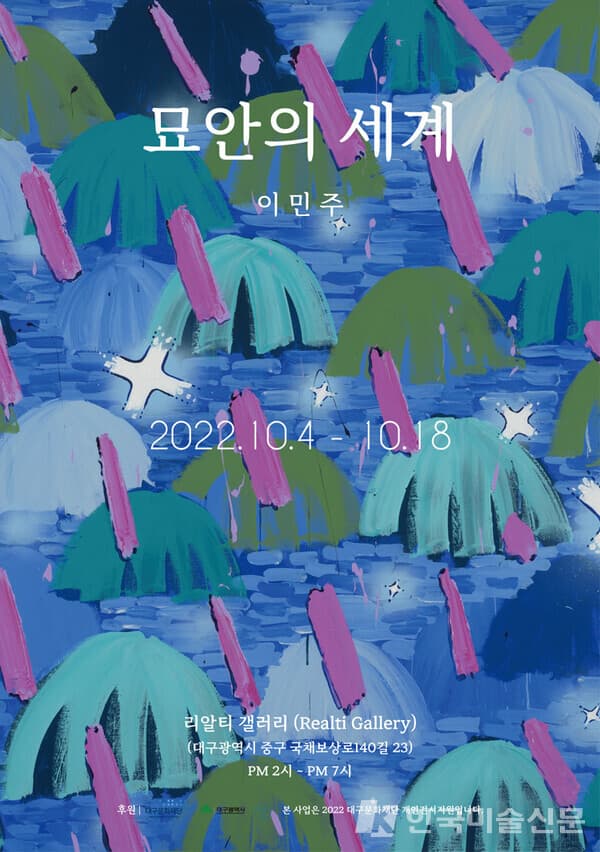
삶과 죽음에 대한 고민은 원초적인 물음이며, 사후세계에 대한 불명확함은 지속적인 고민이자 철학자들을 포함한 모든 인류의 고민이자 접근 불가능한 상상속의 세계면서 실질적인 현실의 문제이기도 했다. 특히, 죽음 이후의 삶에 대한 고민은 예로부터 지속되어왔다. 수많은 석학들이 이 문제에 대해 의논하고 다양한 이론을 펼쳤으나 그에 대한 명확한 대답은 아직도 찾지 못했다. 아니 영원히 결론을 내릴 수 없는 명제인지도 모른다. 그리고 이는 여전히 과학, 철학, 종교 등 다방면에서 인류의 해결과제로 남아있다. 밝혀지지 않은 사실인 이 주제에 대해서 많은 예술가들이 상상의 나래를 펼치며 음악으로, 연극으로, 글로 그리고 미술로도 표현하였다. 죽은 이를 기리기 위해 죽음을 찬미하거나, 새로운 시작이라는 이야기를 하기도 하지만, 보통 죽음은 끝 또는 부정적인 것으로 여겨진다. 어쩌면 무거운 죽음과 이것이 머무는 공간인 무덤이라는 단어는 입을 떠나는 순간부터 주변의 분위기마저 어둡게 만든다.
작가 이민주는 무덤과 죽음 이후의 시간을 새로운 시각으로 제시한다. 가족의 장례를 지내며 느끼게 된 감정들이 그의 예술세계에 변화를 가져왔다. 삶의 축적과 이동을 주제로 하는 설치작업과 일상의 소중한 것들을 아끼는 마음으로 그려 나갔던 회화작업에서 그를 한발짝 더 나아가게 한 것이다. 그는 2020년 개인전 ‘나의 무덤’을 통해 무덤이라는 제재를 처음으로 다루기 시작했다. 봉분의 모습 안에 자연스럽게 그의 추억과 일상이 녹아 들어있다. 이는 이전의 2018년부터 시작되었던 ‘나의 아름다운 생활’ 시리즈와 연결된 개념으로 작가의 일상에서 소박하지만 기쁨을 주는 것들로 묘 안은 가득 차 있다. 고양이를 포함한 작가 자신의 가족, 감탄을 자아냈던 풍경들, 언젠가는 지겠지만 가장 아름다운 모습으로 만개한 꽃 등이 그것들이다. 일상이 쌓여 인생이 되었고, 그 인생을 지나고 살펴보면 추억이 되듯, 그 모든 것을 작은 언덕을 닮은 ‘나의 무덤’ 안에 정성스레 담아냈다. 그렇기 때문에 그의 작품 속 무덤은 으스스한 느낌보다는 아기자기하고 작은 축제와 같은 분위기를 가졌다.
2021년의 개인전 ‘묘안’에서 무덤은 여전히 작가의 주요 예술적 모티프로 나타났다. 제재가 된 묘안은 사전적 의미인 ‘뛰어나게 좋은 생각(妙案, Brilliant idea)’이라는 의미와, ‘고양이의 눈(猫眼, Cat’s eyes)’, 그리고 말 그대로 ‘묘의 내부(Inside of grave)’라는 세 가지 의미를 모두 포용한다. 그리고 ‘묘안’에서 나온 듯한 ‘유물’ 연작들 속 유물들은 현재 우리에게 매우 친숙한 것들이며, 작가에게는 일상의 파편과도 같은 소재들이다. 선대의 인류가 후대에 남긴 물건 혹은 고인이 생전에 사용하다 남긴 물건이라는 단어의 의미처럼, 현재의 시점에서는 일반적인 것들이지만 미래의 시점에서 봤을 때는 새롭고 그 당시 시대상 또는 작가 이민주의 삶을 이해할 수 있는 오브제들이다. 이 연작은 평면을 넘어서 설치로도 표현된다. 미래 시점에서 과거가 되어 버린 묘 속에서 이미지로만 존재하던 유물들이 실제 우리 눈 앞에 입체로 나타나 마치 관람객이 과거, 현재, 미래가 혼재된 시간 속에서 부유하며 작가의 작품을 관망할 수밖에 없는 상황처럼 느껴진다. ‘묘안’ 연작들 역시 묘 안에서 묘 밖을 바라보는 시선을 추상적인 모습과 멀리서 뿌옇게 보이는 듯한 색채로 제시함으로써 죽음 이후의 풍경에 대해 상상하게끔 한다.
나아가 이러한 작가의 시점은 2022년 ‘묘안의 세계’에서 좀 더 확장된 모습으로 나타난다. 무덤, 유물, 묘안 연작의 이미지들이 공존하며 나타난다. 이로 인해 시공간도 다시점으로 등장한다. 과거의 것인 유물과, 현재 그의 삶인 가족들의 모습, 그리고 미래의 묘에서 바라본 시점까지 한 화면에 나타나면서 작품 속 시간은 과거, 현재, 미래가 공존하는 삶과 죽음의 경계 어딘가로 유추된다. 이러한 시간 속에서 멈춰 있는 것보다 지금 움직이는 것을 포착하여 표현하고자 했던 작가는 작품 속 소재들을 반짝 또는 번쩍이는 듯한 이미지와 부서지고 흘러내린 흔적들로 순간을 기록했다. 이러한 표현들이 존재들의 운동감과 생명력을 느끼게 함으로써 관람객 또한 이 혼재된 시간 속에서 존재하는 한 구성원이 된 다. 인간은 공간과 시간이라는 한계 내에 존재하고 있다. 그렇기에 인간은 생명체로서 생에 대한 본능과 달리 늘 죽음이라는 한계를 상정하고 살아가게 되며 본질적으로 생명은 죽음을 피하는 것이 불가능하다. 하지만 작가 이민주의 작품 속에는 이러한 한계가 존재하지 않는다. 생명과 죽음이 공존하고 있으며 죽음의 색채는 어둡거나 시들어버린 모습이 아닌 생생한 생명력을 여전히 뽐내고 있다. 그리고 부자연스러울 것 같은 그 모습은 매우 평화롭고 일상적이다.
사회학자 에드가 모랭(Edgar Morin)은 『인간과 죽음(1951)』에서 “인간 종은 죽음이 삶 중에 실재해 있는 유일한 종이고, 죽음에 장례를 동반하는 유일한 종이며, 또한 죽은 자들의 사후 생이나 부활을 믿는 유일한 종”이라고 이야기했다. 그렇기 때문에 종교적 맥락에서 죽음은 생의 결산으로 다가와 인간의 생을 비춰주는 시간의 거울이 된다. 무엇보다도 죽음은 인간의 정체성과 관계되는 것이다. 그렇기 때문에 죽음은 삶만큼이나 인간이라는 존재를 잘 드러내 준다. 이렇게 죽음에 대한 인식은 인간을 인간이게끔 하는 기준이 되지만, 일상에서 우리가 죽음에 대해 크게 생각 해 볼 기회가 자주 오지는 않는다. 작가는 작품을 통해 일상 속 존재하는 삶과 생명 속에서 죽음을 볼 수도 있으며, 죽음 속에서 삶과 생명력을 발견할 수 있다는 것을 이야기한다. 하루하루의 작은 것들이 쌓여 내가 되고, 삶이 되며, 이것이 죽음 이후에도 지나간 삶 혹은 존재를 가치 있게 만들어 주는 것이다.
‘자신의 죽음을 기억하라’, 혹은 ‘너는 반드시 죽는다는 것을 기억하라’는 뜻을 가진 라틴어 ‘메멘토 모리(Memento mori)’도 결국에는 죽음의 순간에서 삶의 모습을 되돌아볼 것을 고려하며 살아야 한다는 의미이다. 즉, ‘잘’ 살아야 한다는 것이다. 그리고 미술사에서는 이러한 생각이 17세기 네덜란드에서 그려졌던 죽음을 상기시키는 정물화 또는 꽃 그림으로 나타난 것이라고 본다. 이렇듯 작가 이민주의 작업도 무덤이라는 제재를 통해 ‘잘’, ‘착하게’ 혹은 ‘인간 답게’ 살자라는 의미를 내포하고 있다. 도덕이나 윤리가 무시되고 개인주의와 나 밖에 남지 않은 현 세상 속에서 어쩌면 작가의 이야기는 시대에 뒤 떨어진 도덕론자의 넋두리처럼 보일 수도 있다. 하지만 결국 모든 이가 죽음을 떠 올리면서 할 수 있는, 해야 하는 말을 작가는 이야기하고 있다. “잘 살아라” 라고.
당신은 오늘 잘 살았는가? 이는 곧 먼 훗날 묘 안에서의 바라보는 당신의 세계가 빛이 날 것인지, 당신의 생을 어떻게 평가하는 질문이 될 것이다.
글. 정연진 (독립큐레이터. 예술학) (출처=리알티갤러리)
Concerns about life and death are primal questions, and uncertainty about the afterlife is a constant concern, a concern of all mankind including philosophers, and an inaccessible imaginary world, but also a real problem. In particular, concerns about life after death have been ongoing since ancient times. Numerous scholars have discussed this issue and developed various theories, but a clear answer to it has not yet been found. No, it may be a proposition that can never be concluded. And this still remains a problem for mankind to solve in many fields such as science, philosophy, and religion. Many artists have expressed their imaginations on this subject, which is an undisclosed fact, through music, play, writing, and art. Death is praised to honor the deceased, or a story of a new beginning is said, but death is usually regarded as the end or negative. Possibly, the word grave, which is the space where death and it resides, darkens even the atmosphere around it from the moment it leaves the mouth.
Author Lee Min-joo presents the grave and the time after death from a new perspective. The emotions he felt while attending his family's funeral brought changes to his artistic world. It took him one step further in the installation work on the theme of accumulation and movement of life and the painting work in which he painted precious things of everyday life with a heart. He first began to deal with the subject of the grave through his solo exhibition 'My Grave' in 2020. His memories and daily life are naturally incorporated into the appearance of the burial mound. This is a concept connected to the 'My Beautiful Life' series, which started in 2018, and is filled with simple but joyous things in the artist's daily life. They include the artist's own family, including his cat, landscapes that arouse admiration, and flowers that will eventually fade but are in full bloom in the most beautiful way. Everyday life piled up and became a life, and if you look past that life and look at it, it becomes a memory. That is why the tombs in his work have a charming and small festival-like atmosphere rather than a spooky feeling.
In the 2021 solo exhibition 'My Eyes', the tomb still appeared as the main artistic motif of the artist. The sanctioned idea has the meaning of 'Brilliant idea' in the dictionary, 'Cat's eyes', and literally 'Inside of grave'. embrace all meanings. And the relics in the series of 'relics', which seem to have come out of 'an idea', are very familiar to us now, and to the artist, they are like fragments of everyday life. Like the meaning of the word “things left behind by ancestors to future generations or things used by the deceased during their lifetime, things that are common at the present time, but new from the future, and objects that help us understand the life of the artist Lee Min-joo or the times at that time.” admit. This series is also expressed as an installation beyond the flat surface. From the perspective of the future, relics that existed only as images in a tomb that has become the past appear in three dimensions in front of our eyes, as if the viewer has no choice but to observe the artist's work while floating in a time where the past, present, and future are mixed. . The 'Cat's Eye' series also presents the gaze looking outside the tomb from inside the tomb in an abstract form and blurry colors from a distance, allowing one to imagine the landscape after death.