
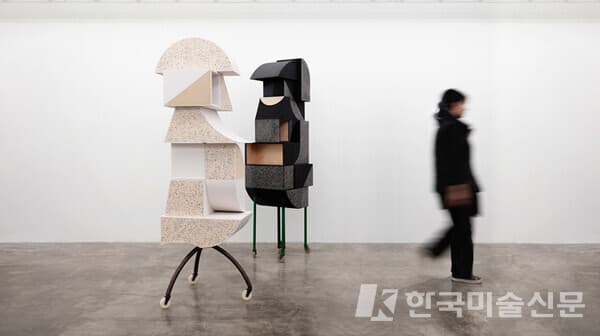
지금 김마저 작가는 어디에 서있나? 그는 지금 가장 중요한 페르소나 즉 변모의 과정을 거치고 있다. 보통의 많은 작가들은 스스로의 보편적 모습에 만족하며 살아간다. 변화의 시도를 두려워하기에 안위하고 안주하는 것이다. 김마저 작가는 과거의 고통스러운 가면 뒤에 숨은 그의 진면목을 모색하며 지난한 ‘개인화 과정’을 밟고 있는지 모른다. 이것은 충만한 저항의식과 끊임없는 자문에 의해 가능하다. 작가는 오랫동안 준비한 이번 전시를 통해 진지하게 정체성에 대해 질문하고 있다.
작가는 삶의 굴곡을 본인의 에고를 통해 발산하고, 작업의지로 반추되어지는데, 김마저 작가의 작업이 산물이 아닌 아직 과정으로 이해하고자 하는 이유는 그 때문이다. 생의 좌표를 다시 점검하지 않을 수 없는 작가의 깊은 목마름은 생활용 가구 디자인을 통해 영위되었고, 그 빌미는 공간에 대한 인식의 변화를 가져다주는 계기가 되었다. 정체를 알 수 없는 두려움과 혼란이야 말로 가장 강력한 창조의 원동력이지 않을까? 붓과 안료를 이용한 과거 작업에서 작품들은 공간으로 나오게 되었다. 회화로 표현 되었던 형태들이 밖으로 나와 목공으로 이어지고 부재와 부재를 휘어서 연결하여 바탕을 만들어 나갔다. 부재의 내구성을 위해 천을 덧대어 바탕을 만드는 전통방식을 이어갔고, 그렇게 만든 바탕 위에다 수십 수백번을 칠하고 갈아내는것을 반복한다. 이것은 노동을 넘어서는 고행으로 작가가 이 프로세스를 견딜 수 있는 것은 아마도 내적 원동력에서 기인한다. 또한 보조 도구인 지그를 사용하여 나무의 굴곡을 표현하고 제작하게 되고 목구조의 형태를 띈 작품들은 서로의 관계 속에서 하나의 전이된 오브제로 재탄생 된다.
작가가 천착된 단어는 ‘인식’인데, 작업의 시작은 사각형을 바라보는 관점의 비틀어짐에서 발현되어, 그 도형이 가지는 경계와 궤적을 작자의 해석에 의해 변형되고 이런 형태를 작가는 고정되지 않는 변형 ‘무각형’으로 지칭하고 무각형으로 유영하는 특징적 형태를 ‘특이성(singularity) 이라 명명하고 싶다. 이 특이성은 주로 직관과 즉흥에 의해 만들어지는 것 같지만, 사실 그 의지의 결정은 명상을 통해 몸이 사라지는 찰라, 무심의 차원에서 잉태된다고 한다. 우연이 아닌 필연이며, 수행의 과정과도 비견할 수 있는 과정이다.
특이성(singularity)은 무수한 기억의 파편들로 작가 작업실의 여기저기서 발견된다. 아직 폐쇄적인 상징 질서 안에 있는 기표 상태로 분류(taxonomy)된 요소는 곧 작가에 의해 재조합된다. 오히려 교합과 부정합을 즐기는 지도 모른다. 이 집적화된 기억(collective memory)은 기의가 되어 유영하고 확산(proliferation)하는데, 두 요소가 동전의 양면과 같다. 기표 없는 기의를 상정할 수 없듯 김마저 작가의 작업 또한 기표를 부정해서 기의를 끌어들이고 다시 기의를 부정해서 새로운 기표를 만들어 나간다.
더 흥미로운 부분은 이 형상화된 작가의 자의성은 작업실의 품을 벗어나 미술관의 환경 속에 놓이는 대목인데, 관람객은 몸의 움직임과 시각의 변화를 통해 작품은 마치 전령사(傳令使)가 된다. 환경으로 인도하는 매질은 평면, 부조, 조각, 설치 미술로 명명하기엔 그 역할을 오히려 한계 하는 것이다. 확장된 세계 속에 경계는 과감하게 허물어지는데, 이번 전시를 통해서도 시공을 넘나드는 오브제간의 연결 퍼포먼스는 확장성에 대한 실험인 것이고, 이 부분이 추후 어떻게 변화할지 기대된다.
또한 ‘움직임’의 등장에 주목한다. 이 움직임은 경계를 넘어서고 다른 관계항의 질서이고 은유이다. Mu(無)_being 이란 작가가 생각하는 존재의 방식의 형태이다. 특이성을 띈 개체들이 서로 영향을 주고 받고 관계 맺음 하면서 움직이는 형태는 무(無)의 상태 즉 고정되어 있지 않는 모습에 가깝다. 이것은 조형 언어로 규정되기보다 주체적인 인격체의 작품으로 개별적 심상과 함께 완결되는 것을 추구한다. 크로노톱(chrontope) 즉 작품에 두드러진 시간적, 공간적 양상들이 작품이 생산된 세계가 아닌, 작품에 의해 인식된 현상학적 세계라는 것은 김마저 작가에게 열려진 공간 수용의 방식인 것이다.
관람객은 이렇게 잘 차려진 반상의 맛을 즐기며 작가와 함께 삶을 반추해 본다는 것은 욕심일까? 나는 이 비비드한 컬러와 도형이 그렇게 화창한 날로만 보이지는 않는다. 오히려 삶의 경계에서 아픔을 넘어 탈출을 시도하는 김마저 작가의 깊은 울림으로 들리는 것은 왜일까? 평면에서 탈출해 공간속에 유영하고 있는 저 기억들은 고요한 아우성인 것이다. 유희로 가득찬 이면엔 긴 시간 수행하듯 경계를 넘어서는 작가의 시간은 힘겨웠다. 멀리 시외버스를 타고 도착한 파주 깊은 곳의 창고안, 글을 쓰기위해 첫 대면한 창고를 개조한 작업실 안은 진공 상태의 우주공간이다. 유영하는 특이성은 고통과 위기에서 태어난 산물로 꽃망울로 터져 나오려 하니, 그게 나만의 생각이진 않을 것이다. 글. 홍재승 건축가
<편집자 주 : 본 미술 평론은 독자들의 작품 이해도를 높이고 미술 정보 전달을 위한 비상업적인 목적입니다. 저작권은 평론가에게 있습니다.>
Where does the artist Kim even stand now? He is now going through the most important persona, the process of transformation. Many ordinary writers live their lives satisfied with their universal appearance. It is to be comfortable and complacent because we are afraid of attempts at change. Artist Kim Majeor may be going through a difficult 'individualization process' while searching for his true nature hidden behind the painful mask of the past. This is possible through a full sense of resistance and constant consultation. The artist is seriously questioning identity through this exhibition, which she has been preparing for a long time.
The artist radiates the twists and turns of life through his ego and is ruminated with his will to work, which is why even Kim wants to understand the artist's work as a process, not a product. The artist's deep thirst for reexamination of the coordinates of life was maintained through the design of living furniture, which served as an opportunity to change the perception of space. Wouldn't the unknown fear and confusion be the most powerful driving force of creation? In past works using brushes and pigments, works came out into space. The forms expressed in painting came out and led to woodwork, and the materials were bent and connected to form the basis. For the durability of the member, he continued the traditional method of making a base by adding cloth, and repeats painting and grinding dozens of hundreds of times on the base. This is an mortification that goes beyond labor. The reason the artist can endure this process is probably due to an inner driving force. In addition, a jig, an auxiliary tool, is used to express and produce the curvature of wood, and the works in the form of a wooden structure are reborn as a transferred object in the relationship with each other.