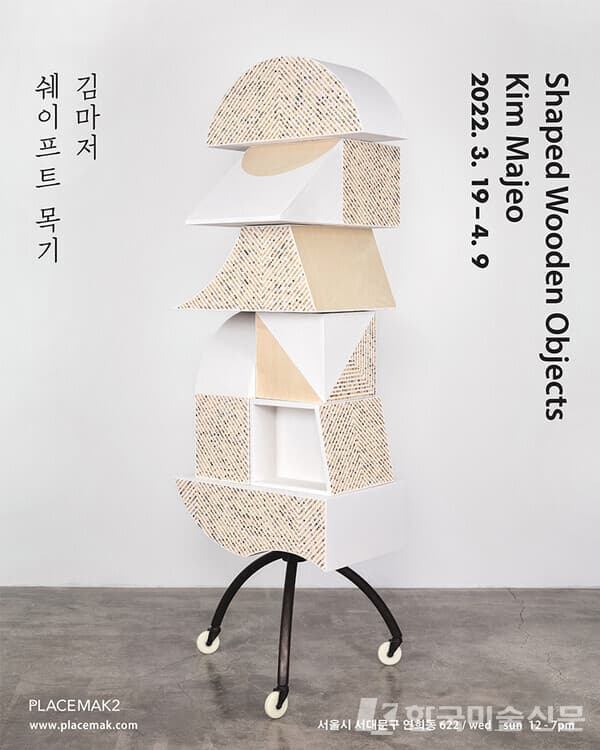
우리가 일반적으로 생각하는 가구는 네모반듯한 직사각형의 상자 형태로 이루어져 있다. 그것은 수납의 편리함과 제작의 용이함을 위해 오랫동안 당연시되어온 전통이다. 그러나 김마저의 목기는 그러한 상식을 뒤집는 즐거운 유희가 있다. 일반 가구에서 좀처럼 찾아볼 수 없는 예각이나 둔각뿐만 아니라 미묘하게 휘어진 곡선이 등장한다. 때로는 목재를 엿가락처럼 휘어 쉼표처럼 생긴 형태가 나오기도 한다. 이러한 형태를 드로잉하는 것은 가능하지만, 유연성이 없는 단단한 목재를 실제로 이렇게 자유롭게 변형시켜 만드는 것은 매우 어려운 일이다. 이러한 변형을 위해서는 나무로 먼저 ‘지그’(jig)라는 특수 보조용 기구를 만들어야 한다. 이른바 ‘쉐이프트 목기’라고 부를 수 있는 이러한 작품은 이처럼 번거로운 과정을 거쳐 만들어진 것이다.
부조 형식의 결과물을 보여주는 김마저의 쉐이프트 목기는 구체적인 기능이 정해지지는 않았지만, 무언가 올려놓아도 좋을듯한 잠재적 공간을 이루고 있다. 이것은 가구의 기능적 공간을 심리적 공간으로 변형시켜 공예의 기능성과 예술의 자율성을 화해시킨 것이다. 그녀는 이런 방식으로 공예와 예술, 기능성과 자율성, 가구와 조각 같은 이분법적 분류를 무너뜨리고, 그 경계에서 그 어느 것도 희생시키지 않으면서 중도적 자유를 누리고 있다.
이러한 작품은 양식적으로 미니멀리즘의 ‘쉐이프트 캔버스’(Shaped canvas)와 유사하게 보인다. 프랭크 스텔라의 쉐이프트 캔버스는 미술의 자율성을 위해 재현적 일루전을 제거해가는 과정에서 사각의 캔버스를 없애고 그림이 내용이 곧바로 형태가 되게 만들었다. 그래서 작품을 “우리 앞에 존재하는 것은 바로 우리가 보고 있는 것에 지나지 않는다”라는 원칙에 부합하게 했다. 이러한 미니멀리즘의 쉐이프트 캔버스는 삶과 일상을 완전히 제거하고 ‘자기지시적’인 즉물성을 드러내어 현상학적인 현전을 체험하게 했다.
그러나 김마저의 ‘쉐이프트 목기’는 이처럼 자연과 인간을 제거해가는 서양의 미니멀리즘과 달리, 즉물적이고 차가운 미니멀 아트에 뜨거운 인간의 감정과 욕망을 개입시켜 만든 것이다. “형태는 기능을 따른다.”라는 루이스 설리반의 기능주의는 모던 공예의 이상이 되었고, 이를 위해 불필요한 장식을 배제하고 온전히 기능에 따른 형태를 추구했다. 김마저의 쉐이프트 목기는 프랭크 게리가 성냥갑 모양의 모던 건축을 해체하듯이, 이러한 기능주의 가구를 해체하면서 자신의 유목적 욕망과 본성의 유희를 반영한 것이다. 그녀는 이러한 자신의 작품을 “무각(無角)의 유희”라고 부른다.
무각형이란 규정 지을 수 없는 계속 변해가는 비정형 도형의 형태를 지칭한다. 우리는 사각, 삼각으로 수많은 분류를 하고 제도와 규범이라는 틀 안에 코드화되어 있다. -작가노트-
여기서 ‘무각’이란 인위적으로 규정하고 고정된 삼각이나 사각 같은 정형화된 형태에서 벗어나 자유롭게 변해가는 역동성을 의미한다. 이때 ‘무(無)’는 “없다”라는 의미가 아니라 타자와의 관계 속에 끊임없이 유동적으로 변화하기에 “고정되지 않는다”라는 개념에 가깝다. 이러한 무각의 개념에는 수학적으로 고정된 공간이 아니라 지속적인 자연의 시간성과 과정성, 그리고 서로 다른 개체 간의 유기적 관계성에 대한 사유가 담겨 있다. 이러한 사유는 그녀가 심취한 불교의 ‘공’(空)사상에서 비롯된 것으로 보인다.
일찍부터 자아에 관한 탐구에 골몰했던 그녀는 20대 후반, 머리를 깎고 송광사에 들어가 수행을 할 정도로 정신적 갈등이 컸다. 그리고 깊은 명상과 수행을 통해서 어느 정도 정신적 고통에서 벗어날 수 있었다. 사실 자연은 물질적으로 일정하게 마름질 되어 있는 것 같지만, 연속적인 시간의 작용 속에 우연적 만남과 불연속적인 도약이 이루어지며 끝없이 변해가고 있다. 불교의 ‘공(空)’사상은 이처럼 고정된 것이 아니라 상호 작용하며 끝없이 변화하는 ‘연기(緣起)’작용에 주목하여 ‘무상’(無常)과 ‘무아’(無我)를 주장한다.
김마저의 ‘무각’(無角)의 개념은 이러한 불교사상과 깊은 관련이 있다. 인간의 수학적 사고나 지성적 분석은 자연에서 연속적인 흐름과 미세한 차이를 거세하고 동일성으로 대상을 분류하고 이름을 붙인다. 이것은 지속으로 변하는 자연의 흐름에서 일부를 떼어내고 고정하여 얻은 불완전한 지식이다. 이러한 지식은 실용적인 측면에서 유용한 도구가 될 수 있으나 이것을 온전한 것으로 절대시하고 계몽할 때 폭력이 될 수 있다.
김마저의 예술은 이러한 도구적 이성과 지식화된 사회적 권력의 폭력성에 대한 저항에서 비롯된 것이다. 자유로운 영혼을 지닌 그녀는 가부장적 남성 중심 사회에서 겪어야 했던 억압과 경직성을 누구보다도 예민하게 느꼈다. 회화가 주류를 이루었던 초기 작업에서는 이러한 갈등을 보다 직접적으로 표현했다. 결혼 이전의 초기 작품에서는 주로 화려하고 예쁜 플라스틱 조화(造花)를 사실적으로 묘사하여 허구로 치장된 자신의 피상적인 자아를 표현했다. 그러나 평탄치 못한 결혼 생활과 파란만장한 인생의 질곡을 경험하면서 그녀의 관심사는 상처 입은 자신의 내면적 자아로 향하게 된다. 그리고 벌집처럼 수많은 무의식의 방에 저장된 두렵고 불쾌한 기억들을 끄집어내어 민화의 책가도 형식으로 표현하였다.
조선 후기에 유행한 민화 책가도는 높게 쌓아놓은 책더미와 여러 가지 길상과 구복의 상징적 물건들을 정물화처럼 배치한 그림이다. 이때 그림에 트레이드 마크처럼 등장했던 인형 같은 인물상은 바로 억압받고 상처 입은 본인의 자아상이었다. 이러한 자아상을 회화 작품과 목기에 그려 넣었는데, 그녀가 목기 작업을 시작한 계기는 40의 나이에 가구 디자이너로 취직을 하면서부터이다. 상업 가구들을 제작하면서 그녀는 평소 좋아했던 민화의 책가도 형식을 차용하게 된다. 그리고 프랑스 유진 유토픽(Usine Utopik) 레지던시에 참가하여 그림으로만 표현하여 오던 책가도 형식의 작품을 입체 작품으로 제작하여 전시하였다.
무의식에 저장된 상처와 응어리를 구상적 이미지로 풀어내면서 그녀는 자신에게 폭력을 가한 대상의 본질을 사유하게 된다. 그리고 합리적 이성이라는 명분으로 자행되는 은밀한 폭력의 뿌리에 인간의 이분법적 분별심이 자리하고 있다는 걸 발견하였다. 사회적으로 거룩하게 포장된 도구적 이성이 개인의 본성과 욕망을 억누르고 있음을 알아차린 것이다. 이때부터 서랍 같은 사각형의 상자는 개인의 욕망을 억압하고 가두어 질식시키는 도구적 이성의 상징물로 자리하게 된다.
근작인 ‘쉐이프트 목기’는 도구적 이성을 상징하는 사각이나 삼각, 원형 등의 정형화된 도형을 무각의 비정형 가구로 변형시킨 것이다. 이것은 억압받고 상처받은 자아를 직접적으로 노출하는 대신 사회적으로 경직된 규범과 도구적 이성을 유희의 대상으로 삼아 해방의 자유를 누리려는 것이다. 경직된 이성과 사회적 규범을 상징하는 사각형의 정형을 해체하기 위해 그녀는 다양한 방법들을 시도하고 있다. 사각형을 다양한 각도에서 여러 방향으로 늘어놓고 종합하여 재구성하는가 하면, 둘 또는 세 가지 기본 도형을 결합하고 늘리는 과정에서 우연적으로 나온 형태를 포착하기도 한다. 이처럼 입체파적 다시점의 종합이나 서로 다른 도형이 우연적으로 만나 어우러지는 관계속에 새로운 형태로의 도약이 이루어진다. 그리고 그렇게 포착된 새로운 도형을 생명체를 탄생시키듯이 소중하게 조형 언어로 제작하게 된다.
이러한 과정을 통해 탄생한 쉐이프트 목기에는 인간의 분석적 분류체계와 경직된 지식에 저항하여 자유를 구가하려는 그녀의 욕망이 담겨 있다. 니체나 들뢰즈가 주목했듯이, 욕망은 형이상학적인 이데아나 고정된 본질이 아니라 유목적으로 부단히 생성하고 변화하며 다자 간의 거침 없는 만남과 차이들을 생산한다. 이러한 욕망은 이성보다 열등한 개념이 아니라 인간의 수학적 사유와 기하학으로 포착 불가능한 오묘하고 미묘한 자연의 생명력을 현시한다. 그리고 이렇게 만들어진 쉐이프트 목기 일부에 조개껍데기에서 떼어낸 정사각형 모양의 작은 자개들을 규칙적으로 상감하여 작품을 마무리한다. 이것은 규정된 형태를 해체한 후, 새 생명을 탄생시키는 마지막 절차이다. 영롱하고 아름다운 신비를 머금은 자개의 문양은 상처가 아물어 돋아난 새살처럼 시련과 역경을 극복한 치유와 승화를 상징하는 듯하다.
나무는 다른 재료와 달리 잘린 후에도 기후 변화에 민감하게 반응하며 수축과 팽창을 반복한다. 가구의 잔재가 남아 있는 김마저의 쉐이프트 목기는 자신의 조형 의지를 일방적으로 실현하는 게 아니라 생명이 남아 있는 나무와 대화하고 타협하며 만든 것이다. 그래서 그런지 그녀의 작품은 개념적이고 차가운 서양의 쉐이프트 캔버스와 달리 따스한 인간적 온기와 정감이 느껴진다. 이것은 인간과 자연의 친밀한 화해를 추구한 한국 특유의 소박한 전통을 계승한 것이며, 조선 목가구의 훌륭한 전통을 현대적 감각으로 재해석한 것이다.
글. 최광진 미술평론가
<편집자 주 : 본 미술 평론은 독자들의 작품 이해도를 높이고 미술 정보 전달을 위한 비상업적인 목적입니다. 저작권은 평론가에게 있습니다.>
Furniture that we generally think of is made up of square, rectangular boxes. It is a tradition that has long been taken for granted for the convenience of storage and ease of production. However, there is a delightful play that overturns such common sense in Kim Majeo's wooden gi. Not only acute or obtuse angles, which are rarely found in general furniture, but also subtle curved curves appear. Sometimes, the wood is bent like a candy toe to form a comma-like shape. It is possible to draw such a shape, but it is very difficult to actually make such a freely deformed hard wood that is not flexible. For this transformation, a special auxiliary tool called a 'jig' must first be made of wood. These works, which can be called 'shaft woodenware', were made through such a cumbersome process.
Kim Majoo's shape woodenware, which shows the result in relief form, has not been decided on its specific function, but it forms a potential space that would be good to put something on. This is to reconcile the functionality of craft and the autonomy of art by transforming the functional space of furniture into a psychological space. In this way, she breaks down the dichotomous classifications of craft and art, functionality and autonomy, and furniture and sculpture, and enjoys neutral freedom without sacrificing anything on the boundary.
These works look stylistically similar to the 'Shaped canvas' of minimalism. Frank Stella's Shaped Canvas eliminates the square canvas in the process of eliminating representational illusions for the sake of artistic autonomy, and makes the content of the painting immediately become a form. So, I made the work conform to the principle that "what exists in front of us is nothing but what we see." This minimalism shape canvas completely removes life and daily life and reveals 'self-referential' instantaneity, allowing the experience of phenomenological presence.
However, unlike Western minimalism, which removes nature and humans, Majo Kim's 'shaft woodenware' is made by intervening hot human emotions and desires in material and cold minimal art. Louis Sullivan's functionalism that "form follows function" has become the ideal of modern craft, and to this end, unnecessary decorations have been excluded and a form based entirely on function has been pursued. Just as Frank Gehry dismantled matchbox-shaped modern architecture, Kim Majoo's shape woodenware reflects his nomadic desire and playful nature while dismantling functionalist furniture. She calls these works of hers “a play without sense.”
Amorphous refers to the shape of an atypical figure that cannot be defined and continues to change. We categorize countless things into squares and triangles, and are coded within the frame of institutions and norms. -Author's Note-
Here, 'no angle' means dynamics that change freely, escaping from standardized forms such as artificially defined and fixed triangles or squares. At this time, 'nothing' does not mean "nothing", but is close to the concept of "not fixed" because it constantly changes fluidly in the relationship with others. This concept of ignorance contains not a mathematically fixed space, but a thought on the continuous temporality and process of nature, and the organic relationship between different objects. This thought seems to have originated from the idea of 'emptiness' in Buddhism, which she was immersed in.
She was engrossed in the search for self from an early age, and in her late 20s, her mental conflict was so great that she shaved her head and entered Songgwangsa Temple to practice. And through deep meditation and practice, I was able to escape from mental pain to some extent. In fact, nature seems to be materially constant, but it is changing endlessly with accidental encounters and discontinuous leaps in the continuous action of time. The idea of 'emptiness' in Buddhism is not fixed like this, but it insists on 'impermanence' (無常) and 'no self' (無我), paying attention to the action of 'activation' that interacts and changes endlessly.
Kim Majoo's concept of 'no consciousness' is deeply related to this Buddhist thought. Human mathematical thinking or intellectual analysis castrates the continuous flow and subtle differences in nature, and classifies and names objects by identity. It is imperfect knowledge obtained by fixing and fixing parts of the continuously changing streams of nature. This kind of knowledge can be a useful tool in practical terms, but it can be violent when it is considered absolute and enlightened.
Kim Majeo's art originates from this instrumental reason and resistance to the violence of intellectualized social power. With a free spirit, she felt more keenly than anyone else the oppression and rigidity she had to experience in a patriarchal male-centered society. In his early works, where paintings were the mainstream, these conflicts were expressed more directly. In his early works before marriage, he expressed his superficial self decorated with fiction by realistically depicting colorful and pretty plastic artificial flowers. However, as she experiences the unevenness of her marriage and the turmoil of her life, her interest turns to her wounded inner self. And, like a beehive, he brought out the fearful and unpleasant memories stored in countless rooms of the unconscious and expressed them in the form of folk paintings.
The folk painting Chaekgado, which was popular in the late Joseon Dynasty, is a painting in which piles of books and various symbolic objects of auspiciousness and good luck are arranged like a still life painting. At this time, the doll-like figure that appeared as a trademark in the painting was the self-image of the person who was oppressed and wounded. This self-image was drawn into paintings and wooden utensils, and the reason she started working on wooden utensils was when she got a job as a furniture designer at the age of 40. While producing commercial furniture, she borrowed the form of folk paintings that she always liked. He also participated in a residency at Usine Utopik in France, where he produced and exhibited a three-dimensional work in the form of a chaekgado, which had been expressed only in pictures.
As she unravels the wounds and resentment stored in her unconscious into figurative images, she comes to contemplate the nature of the object that inflicted violence on her. And it was discovered that human dichotomous discernment lies at the root of secret violence committed in the name of rational reason. He realized that the socially holy packaged instrumental reason suppresses individual nature and desire. From this point on, the drawer-like square box became a symbol of instrumental rationality that suppresses, confines, and suffocates individual desires.
His latest work, 'Shaft Woodware', transforms standardized figures such as squares, triangles, and circles, which symbolize instrumental rationality, into angleless, atypical furniture. Instead of directly exposing the oppressed and hurt self, this is to enjoy the freedom of liberation by making socially rigid norms and instrumental rationality the object of play. She is trying various methods to dismantle the square shape that symbolizes rigid reason and social norms. Reconstructed by arranging squares in various directions from various angles and synthesizing them, he also captures shapes that came out by chance in the process of combining and stretching two or three basic shapes. In this way, a leap into a new form is made in the synthesis of cubist multi-viewpoints or the relationship in which different figures coincidentally meet and harmonize. And the new figures captured in this way are carefully produced in formative language as if they were giving birth to life.
Shaped woodenware created through this process contains her desire to enjoy freedom by resisting the analytic classification system and inflexible knowledge of humans. As Nietzsche and Deleuze noted, desire is not a metaphysical idea or a fixed essence, but a nomadic, constant creation and change, producing unstoppable encounters and differences among many. This desire is not a concept inferior to reason, but reveals the subtle and subtle vitality of nature that cannot be captured by human mathematical thinking and geometry. In addition, small square-shaped mother-of-pearl removed from the shell is regularly inlaid on a part of the shape woodenware made in this way to finish the work. This is the final procedure to give birth to a new life after dismantling the prescribed form. The mother-of-pearl pattern, which has a brilliant and beautiful mystery, seems to symbolize healing and sublimation overcoming trials and adversity, like new skin that has healed and sprouted.
Unlike other materials, wood responds sensitively to climate change and repeats contraction and expansion even after being cut. Kim Majoo's wooden shapeware, which has remnants of furniture, is not a unilateral realization of his formative will, but a dialogue with and compromise with trees that remain alive. Maybe that's why her work feels warm human warmth and emotion, unlike the conceptual and cold shape canvas of the West. It inherits Korea's unique simple tradition of pursuing intimate reconciliation between humans and nature, and reinterprets the fine tradition of wooden furniture from the Joseon Dynasty with a modern sense.
[번역=한국미술신문]