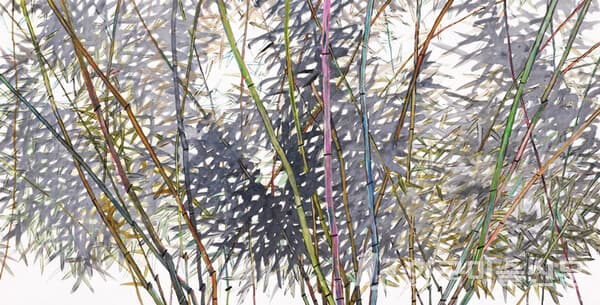
▲ 박앵전, 매화를 넘어 대나무 숲으로 가다135 x 70cm, Mixed Media, 2022. 사진=인사아트프라자갤러리(Insaartplaza Gallery)
“‘매화는 내 삶의 연결고리' 매화 향기는 저절로 나는 게 아니라 혹독한 추위를 견딘 뒤에야 비로소 짙은 향기를 뿜어냅니다. 매화는 이른 봄 제일 먼저 꽃을 피웁니다. 꽃이 작아 화려하지는 않지만 고풍스럽고, 고결하며 그윽한 향기 또한 운치를 더해 줍니다. 나는 매화를 사랑합니다. 나의 삶 속으로 말없이 다가와 위로와 인내를 전해 준 매화입니다.”
녹원(綠元) 박앵전 작가는 2년 전 개인전 <심매尋梅의 여흥과 문기>에서 그녀가 매화를 그릴 수밖에 없는 속내와 심경을 간절하고 따뜻하게 고백했다. 물론 매화가 가지는 매력은 이뿐만이 아니다.
“매일생한 불매향” (梅一生寒 不賣香)이라고 매화는 일생 동안을 추운 밖에서 자라 겨울을 나고 봄에 꽃을 피우지만 그렇다고 해서 결코 향을 팔지 않는 지조도 있다.
이른 봄의 추위를 무릅쓰고 제일 먼저 꽃을 피운다는 매화가 많은 예술가에게 아름다운 모습이나 지조의 상징으로 시와 그림에 빈번하게 나타나는 이유이다. 그래서 일생을 독신으로 매화와 더불어 칩거 생활을 한 송나라 시인 임포(林逋) 이후로 문인들 사이에서 눈 덮인 매화나무 가지에 처음 피는 꽃을 찾아 나서는 심매(尋梅)가 문인들의 연중행사로 유명했다.
이토록 매화에 심취했던 그녀가 이번에는 문인화의 필법을 뛰어넘어 현대회화로도 부족함이 없는 작품으로 대나무 숲을 보듬고 돌아왔다. 작가는 2년 전 개인전에서 이러한 대나무 숲으로의 변신을 예고하는 대나무 채색 수묵화 200호 크기의 대작 1점을 살짝 공개했었다.
그러나 사군자의 매화에서 대나무로의 주제만 바꿀 줄 알았는데 작년 방문한 작가의 작업실에는 그 예상을 완전히 뒤엎었다. 실제 광양의 대나무 숲을 방불케 할 만큼 온통 대나무 그림으로 넘쳐났고, 그뿐만 아니라 표현과 스타일, 색채에서 기법도 표현양식도 장엄한 100여 점 이상의 대나무 숲으로 가득 차 있었다.
그 대나무 숲들은 오랫동안 문인화와 서체를 필법으로 다져온 필력과 탄력적인 기술로 화폭 곳곳에서 서걱대며 넘쳐났다.
분명 박앵전은 이러한 대나무만으로 화면을 아우르고 포치 하는 역량에 모든 것을 건듯했다.
그 대나무숲에는 바람이 일었고, 그 미풍은 화폭 우측에서 좌측으로 넘실거리며 때로는 농담 필법의 붓질로 완벽한 하나의 묵죽화(墨竹畫)로 감싸놓은 파노라마의 풍경을 펼쳐냈다.
포근한 봄날의 새순을 느끼게 하는 기운의 대나무 숲인가 하면, 훈훈한 여름의 대나무 숲도, 가을 단풍의 대나무숲은 물든 소동파의 붉은 주죽도처럼 화사하게 전개되었다.
그런가 하면 그의 또 다른 숲은 해강 김규진의 <눈 쌓인 대나무 숲>을 끊임없이 떠올릴 정도로 격조와 품격을 더했다.
이렇게 사계절의 자연 풍광이 박앵전의 대나무 숲에는 오롯하게 담겨 있었다.
그 대나무 숲 사이로 봄바람도 지나가고, 훈훈함도 뿜뿜 다가온다. 거친 듯 앙상한 대나무에는 비록 잎이 없어도 그 마디에 견고함이 기존의 사군자 필법을 넘어 전통적 화법에 구애를 받지 않으면서 개성적인 대나무 숲이 탄생 된 것이다.
일찍이 중국 북송의 시인 소동파는 “마음속에 대나무를 그린다는 것은 먼저 마음속에 대나무의 싹을 심는 것이며 그 싹 즉 죽순이 장대하게 뻗어 나가는 모습을 꿈꾸는 일이다”라고 했다.
박앵전의 그림 속에서 이처럼 어린 대나무의 가녀림과 힘차게 올라가는 힘참이 어울려 조화를 이루려는 꿈을 발견하는 것은 작가의 열정이 그와 다르지 않기 때문이다.
그래서 여류화가의 그림이라고 생각하기에는 쉽게 상상할 수 없는 군자다운 기질과 기품도 작품 곳곳에서 풍긴다.
그렇게 먹으로 그린 대나무의 골격과 구성이 적절한 색상과 균형의 깊이를 지니면서 그녀의 대나무 숲은 평온하기도 적요하기도 하다.
아마도 이러한 표현이 가능한 것은 판교 정섭(중국 청대 양주팔괴의 화가)이 강조한 '격'이 없는 시나 그림은 껍데기일 수 있다는 말처럼 박앵전의 그림이 “안중지죽(眼中之竹)에서 흉중지죽(胸中之竹)으로, 그리고 수중지죽(手中之竹)과 그대로 닿아있음은 확실해 보인다.
눈으로 보는 대나무로서 객관적인 대나무 형상과 안목과 관찰력, 결코 함부로 그림은 공허하지 않은 '흉중지죽'으로서 가슴 속의 대나무, 가슴에서 우러나오는 진정과 깊이 있는 대나무를 보는 감성이 그대로 우러나 우리에게 평안과 정중동의 감성을 화폭이 열어 보인다.
아울러 마음속 깊은 심연에서 대나무가 우려내는 기상과 진정성과 기운을 보는 이가 체감한다는 것은 그림이 주는 또 다른 즐거움이기도 하다.
그의 작품들은 여기에 그치지 않는다. 비가 내려 촉촉이 젖어 있는 대나무를 보는듯한 우죽도(雨竹圖)가 있는가 하면, 속세의 티를 씻어낸 맑고 청아한 대나무 숲도 돋보인다.
그래서 박앵전의 대나무는 탄력이 있고 유연하며 종종 괴석과 만나면서 여유로움과 생생함의 강인함과 견고한 죽석도로 일체를 이룬다.
화폭의 형태도 종형과 횡형으로 제작한 작품에서 그 대나무 숲은 팽팽한 긴장감을 의도적으로 강조한다.
이제 작가는 바람에 흔들리는 대나무의 동양적 미감을 현대회화에 접목하면서 특유의 조형적 세계를 선언한 것으로 기대된다.
특히 담백과 채묵으로 원근감과 배경을 혼합하는 형식들은 다른 풍경에서 볼 수 없는 독자성을 보이기도 한다. 종종 화폭 앞부분에 위치한 뚜렷한 대나무, 뒤쪽에는 짙은 안개에 휩싸여 흐릿하게 보이는 대나무들이 어울려 죽림의 아련한 분위기는 주목할 만하다.
괴석들과 함께 한 대나무 그림 또한 다양하게 각기 다른 배경과 구성으로 대나무의 잎사귀, 줄기, 마디, 바위 모습에 파격적인 변화를 주는 양식에서 또한 박앵전 작품의 눈여겨 볼만한 특징으로 손꼽힌다.
그 가운데 나는 대나무 뒤로 눈이 아련하게 내린 쌓여 있는 모습에 푸르고 엷은 담묵으로 다듬은 대나무 줄기와 잎의 눈 쌓인 작품은 단연 박앵전 작가의 수작으로 눈이 간다.
마치 고산 윤선도가 「오우가(五友歌)」에서 나무도 아닌 것이 풀도 아닌 것이 곧기는 뉘가 시켰으며, 속은 어이 비었는가 저렇게 사시에 푸르니 그를 좋아하노라 읊었던 것처럼 인상에 남는다.
그 마디가 견고함에 감탄하여 먹의 짙고 옅음에 변화를 주어 원근감으로 뚜렷하고 차분한 느낌인 것이다.
이외에도 사실성을 좀 더 강조한 그림과 줄기가 굵은 통죽의 음영 효과를 잘 살려 입체감을 두드러지게 표현하고 거기에 강한 필치로 몇 개의 잎을 가해 놓은 것들도 특질적이다.
이처럼 박앵전의 대나무숲은 죽림(竹林)처럼 변화 많은 먹의 농담으로 표현한 그림도 인상적이다.
이렇게 기억에 반복적으로 어른거리는 작품들이 있는가 하며 아쉬움도 있다. 너무 대나무의 본디 형태와 색채에 닫혀 있지 않은가 하는 점과 대나무의 색채가 주변의 배경과 조화가 이루어지지 않고 유리된 인상을 주는 작품들이 있어 유감스럽다. 구성에서도 좀 더 여유 있고 과감하게 생략과 여백을 자유롭게 다루었으면 하는 생각을 하게 한다.
그러나 박앵전 작가가 대나무 숲 화폭에 빠진 그 뜨거운 예술적 열정을 보노라면 작가도 틀림없이 북송시대의 문인화가 문여가(文與可)가 '화죽이론(畵竹理論)'에서 대나무 그릴 때는 중요한 것이 '먼저 마음속의 대나무를 그리라'는 것이다. 반드시 먼저 마음속에 대나무를 완성하고 나서 붓을 들고 자세히 바라보아야 그리고자 하는 것이 보일 것이니 그때 서둘러 붓을 휘둘러서 그림을 그려야 좋은 그림이 완성될 수 있다는 것에 절대적으로 교감하고 공감했음은 분명해 보인다.
글. 김종근 (미술평론가)
<편집자 주 : 본 미술 평론은 독자들의 작품 이해도를 높이고 미술 정보 전달을 위한 비상업적인 목적입니다. 저작권은 평론가에게 있습니다.>
“'Maehwa is the link in my life' The scent of plum blossoms does not come naturally, but only after enduring the harsh cold. Plum blossoms are the first to bloom in early spring. The flowers are small and not flashy, but the antique, noble and profound fragrance also adds to the taste. I love plum. It is a plum blossom that silently came into my life and delivered comfort and patience.”
Artist Nokwon (綠元) Park Aeng-jeon earnestly and warmly confessed her inner thoughts and feelings that forced her to draw plum blossoms in her solo exhibition <Shimmae's Entertainment and Visitation> two years ago. Of course, this is not the only attraction of plum blossoms.
There is also a jizo that plum blossoms grow outside in the cold for their entire life, survive winter and bloom in spring, but that does not mean that they never sell incense.
This is why plum blossoms, which are said to bloom first despite the cold of early spring, often appear in poems and paintings as a symbol of beauty or fidelity to many artists. So, since Lin Po, a poet of the Song Dynasty, who lived a life of seclusion with plum blossoms as a single person, Sim-mae (尋梅), which seeks the first flowers that bloom on the branches of a snow-covered plum tree, has become famous as an annual event among literary men. .
She, who was so obsessed with plum blossoms, came back after embracing the bamboo grove with a work that goes beyond the brush strokes of literati painting and is not lacking in modern painting. In his solo exhibition two years ago, the artist slightly unveiled a masterpiece of bamboo color and ink painting No. 200, predicting the transformation into a bamboo forest.
However, I thought only the theme of the Four Gracious Plants would change from plum blossom to bamboo, but the artist's studio I visited last year completely overturned my expectations. It was overflowing with bamboo paintings reminiscent of the actual bamboo forest in Gwangyang, and it was also filled with more than 100 bamboo forests that were magnificent in terms of expression, style, color, technique, and style of expression.
The bamboo groves overflowed from all over the canvas with the penmanship and flexible technique that he had cultivated for a long time in literati painting and calligraphy.
Clearly, Aengjeon Park staked everything on his ability to encompass and cover the screen with only these bamboos.
A wind blew in that bamboo grove, and the breeze swayed from the right side of the canvas to the left, sometimes unfolding a panoramic landscape wrapped in a perfect ink bamboo painting with light and shade brush strokes.
If it is a bamboo grove of energy that makes you feel the new sprout of a warm spring day, the bamboo grove of warm summer, and the bamboo grove of autumn leaves are brightly developed like the red-skinned bamboo of Sodongpa.
On the other hand, his other forest has added class and dignity to the extent that it constantly reminds me of Haegang Kim Kyu-jin's <Snowy Bamboo Forest>.
In this way, the natural scenery of the four seasons was fully contained in the bamboo forest of Park Aengjeon.
The spring breeze passes through the bamboo grove, and the warmth comes. Even though the rough and bony bamboo has no leaves, the solidity of its nodes goes beyond the existing four gentleman brush strokes, and a unique bamboo forest was born without being bound by traditional painting techniques.
Earlier, Su Dongpo, a poet from the Northern Song Dynasty in China, said, “To draw a bamboo in your mind is to first plant a bamboo shoot in your mind, and to dream of the sprout, or bamboo shoot, spreading out magnificently.”
In Park Aeng-jeon's paintings, we find the dream of harmonizing the slenderness of young bamboo with Himcham, which rises vigorously, because the artist's passion is not different from that.
Therefore, the temperament and dignity of a gentleman, which cannot be easily imagined to be a painting by a female artist, are also exuded throughout the work.
The frame and composition of the bamboo drawn with ink have the proper color and depth of balance, and her bamboo forest is peaceful and serene.
Perhaps this expression is possible, as Pangyo Jeong-seop (a painter of the Yangzhou Eight Valleys of the Qing Dynasty) emphasized, saying that a poem or painting without 'character' can be a shell. It seems certain that it is in direct contact with the bamboo) and the bamboo in the palm of your hand.
As bamboo that is seen with the eyes, objective bamboo shape, discernment, observation, and painting are never empty. The canvas opens up the emotions.
In addition, it is another pleasure of painting that the viewer can feel the spirit, sincerity, and energy that bamboo brews from the deep abyss of the heart.
His works do not stop here. There is Ujukdo (雨竹圖), which looks as if you are looking at bamboo moistened by rain, and the clear and elegant bamboo forest that has washed away dirt from the world is also outstanding.
Therefore, Park Aeng-jeon's bamboo is resilient and flexible, and often encounters odd stones, forming a unity with the strength of leisure and vividness and solid bamboo stone swords.
The bamboo grove intentionally emphasizes the tension in the work, which is made in both vertical and horizontal canvases.
Now, the artist is expected to declare a unique formative world by grafting the oriental aesthetic sense of bamboo swaying in the wind to modern painting.
In particular, the forms that mix perspective and background with light and shaded ink show a uniqueness that cannot be seen in other landscapes. It is noteworthy that the dim atmosphere of the bamboo grove is often harmonized with the distinct bamboos located in the front part of the canvas and the bamboos that appear blurry due to the thick fog in the back.
Bamboo paintings with strange stones are also considered as one of the noteworthy features of Park Aeng-jeon's work in the style of making radical changes to the leaves, stems, nodes, and rocks of bamboo with various backgrounds and compositions.
Among them, I see snow piled up faintly behind the bamboo, and the snowy work of bamboo stems and leaves trimmed in blue and light gray is definitely the masterpiece of artist Park Aeng-jeon.
It leaves an impression as if Gosan Yun Seon-do recited in 「Ohuga(五友歌)」 that who ordered that neither tree nor grass straightened, and that he was so empty inside and that he was so green at the time.
Admiring the solidity of the joints, the dark and light colors of the ink are changed to give a clear and calm feeling through perspective.
In addition, the painting that emphasizes realism and the shading effect of thick stems are well used to express the three-dimensional effect prominently, and those in which several leaves are applied with strong strokes are also characteristic.
Like this, Park Aeng-jeon's bamboo forest is also impressive in his paintings expressed in light and shade with many variations like a bamboo grove.
There are works that repeatedly stir in the memory like this, and there is a sense of regret. It is regrettable that there are works that are too closed to the original shape and color of bamboo, and that the color of bamboo does not harmonize with the surrounding background and gives the impression of being isolated. In the composition, it makes me think that I want to be more relaxed and boldly deal with omissions and blanks freely.
However, if you look at Park Eng-zhen's passionate artistic passion for painting in a bamboo forest, the artist must be sure that the Northern Song Dynasty's literati painter Wen Rujia (文與可) draws bamboo in his 'Painting and Bamboo Theory (畵竹理論). Draw the bamboo in your heart'. It is clear that he absolutely sympathized with and sympathized with the idea that a good painting can only be completed by quickly swinging the brush at that time, since you must first complete the bamboo in your mind and then take a closer look at it with a brush to see what you want to draw.