다수의 사상가들은 인간이 더 이상 독립적인 주체로서 객체와 유리된 채 존재할 수 없음을 주장한다. 또한 근대주의적 사유에서 벗어나지 못한 20세기를 지나 사상은 인류가 자연 세계와 동떨어진 채 인간들끼리의 관계에서만 살아오지 않았다는 사실을 명확히 인식하게 된다. 인간과 비인간, 주제와 객체, 사회와 자연을 구분하는 근대적 이분법의 결점이 드러나면서 각기 다른 존재들은 상호 관계를 통해 다층적인 의미를 생성한다는 사실을 알게 되었다.
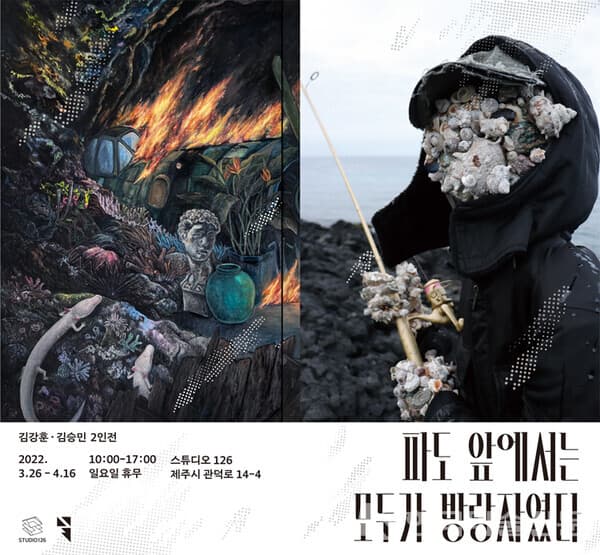
<파도 앞에서는 모두가 방랑자였다>는 김강훈, 김승민 작가가 인간을 둘러싼 다양한 존재를 탐구하며 바라본 ‘공존’의 의미를 키워드로 삼는다. 김강훈은 인간과 인간 사이로부터, 김승민은 인간과 관계한 환경으로 확장해 나간다.
김강훈 작가는 나와 타자, 그리고 제 3자의 공존에 관한 이야기를 다룬다. 여기에서 제 3자란, 각자의 견해를 가진 주체가 아니라 묵묵히 자리하며 양자를 객관적으로 바라보는 시선을 의미한다. 그것은 그 자리에 존재함에 의미가 있다. 주관적인 시각이나 의견을 가지기보다는 ‘나’ 자신이 윤리적인 주체가 될 수 있도록 지지하는 어떠한 시선이다. 작가가 지속적으로 그려온 회화 작업에는 ‘비(雨)’가 등장한다. 자연적 현상인 날씨는 누구에게나 공평하게 주어지는 삶의 일부이다. 여기서 비의 시선은 나와 타자를 동시에 바라보는 제 3자의 시선을 상징하며 소유하거나 향유할 수 없고 세계 내 모든 존재들의 동등함을 지향하는 ‘침묵의 시선’을 의미한다. 이번 출품작에서는 특히 구화지문(口禍之門)(입은 재앙을 불러들이는 문이 된다)에서 제 3자의 침묵성을 자연이 아닌 인간의 모습으로 환원하여 윤리적 주체로서의 ’나‘에 대해 사유하는 작가의 고민이 드러난다.
김승민 작가는 실제 자연과 가공된 자연을 실재와 이상에 비유하며 그 사이에서 느낀 낯익은 낯설음(uncanny), 과정에서 생성되는 이미지의 충돌과 감정을 화폭에 담아낸다. 2021년부터의 작업에서는 우리가 현재에도 겪고 있는 특수한 재난을 바다에 잠긴 세계로 묘사하면서 ‘디스토피아(dystopia; 역 유토피아, 현대사회의 부정적인 측면들이 극대화되어 나타나는 어두운 미래상)’를 제시한다. 등장하는 인물들은 주위 환경을 적극적으로 탐구하는 제스처를 취하는데 이전 작업에서의 소극적인 자세와는 대비된다. 이것은 인간의 노력으로 현대 사회의 부정적인 문제를 극복할 수 있다는 희망적인 메시지, 혹은 자연 그 자체의 강인한 생명력을 전달하고자 함이다. 즉 작가는 환경 문제에 대한 위기 의식, 공존의 가치, 극복의 메시지를 전달하고자 한다.
반려자(companion)라는 말은 ‘빵을 나눈다(cum panis)’라는 라틴어에서 비롯되었다고 한다. 우리가 흔히 사용하는 (한솥밥을 먹는) ‘식구’의 의미와 같다. 개인은 관계에서 분리되어 존재하지 않으며 상대 없이는 존재할 수도 없다. 이것이 반려의 의미이며 그 영역이 한정되지 않는다. 나와 관계하여 공존하는 것(타자, 제 3자, 보편적인 인간, 자연, 환경 등)은 모두 반려의 대상이다.
미국의 학자인 도나 해러웨이는 “사태를 긍정과 부정 중 하나로 환원하지 않고 이 둘 모두 에 충실할 수 있는 자세, 매 순간과 매 관계에 고유한 문제 속에서 책임있게 응답할 수 있는 능력(response-avility)을 배양하는 것이 오늘날 필요한 윤리적 태도다.”라고 강조했다.
김강훈, 김승민 작가는 이번 전시를 통해 오늘날 우리에게 필요한 윤리적 태도가 무엇인지를 다시금 돌아보고 ‘공존’의 가치를 공유하고자 한다. 모든 것이 평등한 관계에서 수평적으로 존재하고 공존하는 관계로 재정립할 수 있다면, 세계를 새롭게 이해하는 윤리적 실천들이 생겨날 것이라고 믿는다.
글. 권주희 스튜디오126 디렉터
<편집자 주 : 본 미술 평론은 독자들의 작품 이해도를 높이고 미술 정보 전달을 위한 비상업적인 목적입니다. 저작권은 평론가에게 있습니다.>
Many thinkers argue that human beings can no longer exist as independent subjects separated from objects. In addition, after the 20th century, which did not break away from modernist thought, thought clearly recognized the fact that mankind did not live only in relationships with humans apart from the natural world. As the flaws of the modern dichotomy that divides humans and non-humans, subjects and objects, and society and nature are revealed, it is learned that different beings create multi-layered meanings through mutual relationships.
<Everyone was a wanderer in front of the waves> uses the meaning of 'coexistence' as a keyword as writers Kim Kang-hoon and Kim Seung-min explore various beings surrounding humans. Kim Kang-hoon expands from human to human, Kim Seung-min expands to the environment related to humans.
Artist Kim Kang-hoon deals with the story of the coexistence of me, the other, and a third person. Here, the third party does not mean a subject with their own views, but a gaze that objectively looks at both of them, standing silently. It has meaning in being there. Rather than having a subjective view or opinion, it is a certain point of view that supports 'I' to become an ethical subject. 'Rain' appears in the painting work that the artist has continuously drawn. The weather, a natural phenomenon, is a part of life given equally to everyone. Here, the gaze of rain symbolizes the gaze of a third person who looks at me and the other at the same time, and means a 'silent gaze' that cannot be owned or enjoyed and aims for equality for all beings in the world. In this exhibition, in particular, in Guhwajimun (mouth becomes a door that invites disaster), an artist who thinks about 'I' as an ethical subject by reducing the silence of a third person to a human figure, not nature. concerns are revealed.
Author Kim Seung-min compares real nature and processed nature to the real and the ideal, and captures the familiar uncanny felt between them and the collisions and emotions of images created in the process on canvas. In his work from 2021, he presents a 'dystopia' (a reverse utopia, a dark future in which the negative aspects of modern society are maximized) by describing the special disasters we are currently experiencing as a world submerged in the sea. The characters appearing take gestures of actively exploring their surroundings, which contrasts with their passive attitudes in previous works. This is to convey a hopeful message that human efforts can overcome the negative problems of modern society, or the strong vitality of nature itself. In other words, the artist wants to convey a sense of crisis about environmental problems, the value of coexistence, and a message of overcoming.
The word companion comes from the Latin word cum panis, meaning to share bread. It is the same as the meaning of 'family' that we commonly use (eating a pot of rice). The individual does not exist apart from the relationship and cannot exist without the other. This is the meaning of companion, and the area is not limited. All things that coexist in relation to me (others, third parties, universal humans, nature, environment, etc.) are objects of companionship.
Donna Haraway, an American scholar, said, “An attitude to be faithful to both without reducing a situation to either positive or negative, the ability to respond responsibly in the challenges unique to each moment and each relationship (response-ability) ) is the ethical attitude needed today.”
Through this exhibition, artists Kang-hoon Kim and Seung-min Kim intend to look back on what ethical attitudes we need today and share the value of 'coexistence'. I believe that if everything can be reestablished from an equal relationship to a relationship that exists horizontally and coexists, ethical practices that newly understand the world will arise.