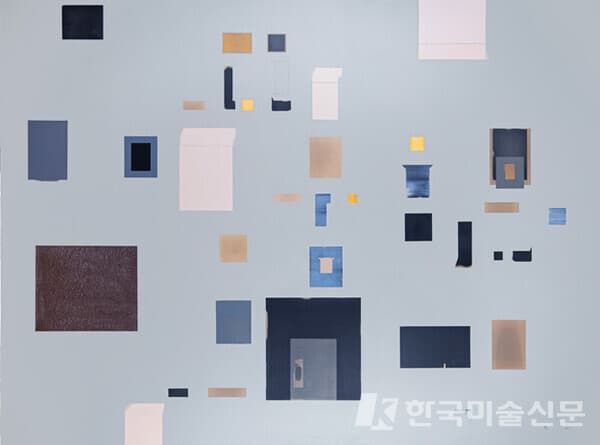
배삼식은 사각의 네트워크를 통해 삶 자체를 대변하는 솔직한 작가이다. 작품의 근저에는 풍요가 흐르고 동서고금의 사유들이 뒤섞인 오늘의 시대를 진정성 있게 담아낸다. 돌가루를 아교에 섞어 젤로 만든 판을 얹어내고, 릴리프 느낌의 부조물을 작품으로 녹여내는 작업, 보조제가 중심이 되는 과정들은 주변부를 중심으로 만드는 작가의 인생철학과 관계돼 있다. 소재주의를 탈피하여 보이지 않는 가치를 창출하고, 모든 재료를 경험한 이후 자생적으로 터득한 경험의 레이어를 단순한 평면성으로 환원한 것이다. 작가는 문화와 역사에 대한 서술에서도 “한국적이라는 것은 의도적인 창조가 아닌 한국인으로서의 자생성을 찾아가는데 있다.”고 말한다. 안정적인 풍요의 시대 속에서 미래지향적 긍정을 향한 행보는 나이를 잊은 도전정신으로 이어진다. 배삼식은 조각에서 익힌 기술과 기법, 실험 과정에서 오는 탁월함을 통해 사각의 네트워크와 대화하는 ‘자생적 추상’을 만나게 된 것이다.
사각이 품은 디테일과 ‘한국적 충만’
위(Top View)에서 본 건축도면을 연상시키는 세련된 큐브들이 신구건축의 조화로움을 상징하듯 춤을 춘다. 마치 유명 건축가가 옛 상징물 위에 새로움을 더해 설계하듯, 배삼식 작가는 회화면서도 조각 같은, 부조면서도 건축 같은 사각의 미학을 유기적 네트워크로 그려낸다. 용산의 랜드마크가 된 데이비드 치퍼필드(David Chipperfield)의 아모레퍼시픽 사옥을 연상시키는 최근작들은 구시대의 고전건축 위에 최첨단의 구조물을 이어붙인 듯 독특한 분위기를 자아낸다. 풍화된 석재의 시간과 모던건축이 필더링된 듯 한 색조, 소외된 재료를 중심으로 옮겨내는 따스함, 청년 같은 열정 속에서도 통일성 있는 어휘, 사각의 배열이 만들어낸 무기교의 패턴은 어디서도 본적 없는 독창성을 갖는다. 차이와 반복으로 이끌어내는 미적 성취는 오늘날 현대미술 만들어내는 과거와 현재, 미래를 잇는 방법론이기도 하다. 작가는 이에 대해 “진정성을 바탕으로 한 작품들은 사람들과 어떤 관계를 맺느냐에 따라 계속해서 진화하는 발전과정”이라고 말한다. 삶과 일체된 작업방식이 곧 ‘진정성의 표출(Expressing sincerity)’인 셈이다.
모더니즘이나 해체주의와 같은 아방가르드적 시도보다 조화와 균형, 작업 전반에 걸친 차분함과 완성도를 추구하는 방식은 작가가 언급한 ‘Sincerity’의 바탕을 이룬다. 그 때문에 작품들은 한국인 특유의 차분하면서도 당당한, 무계획 속에서도 순수한 본질에 가까운 미적성취를 발현한다. 새로움의 충격보다 더할 나위 없는 ‘꽉 찬 충만’을 통해 무한한 가능성을 제시하는 것이다. 과감하게 비워낸 사이의 공간들은 사각의 반복이 창출한 영역들로, 작가 녹여낸 디테일 속에서 우연과 필연을 종합한다. 꽉 찬 충만(正=사각의 텍스트)과 텅 빈 가능성(反=여백의 컨텍스트)은 허실상생(虛實相生)하는 가운데 조화미(合)로 거듭나는 것이다. 잘 계획된 도시들이 보이드(뚫린 공간)를 만들어 중심과 주변을 이어내듯, 배삼식의 작품들은 깊이 있는 정갈함을 통해 ‘충만함의 그 자체’를 창출한다. 우리가 작품 속에서 편안한 공간감을 느끼는 것은 세세히 기록된 사각의 패턴들이 어느 것 하나 어긋나지 않는 ‘맥락의 일치(네트워크의 조화)’를 보여주기 때문이다. 그러하기에 배삼식의 작품들은 차이와 반복이 만들어내는 정갈함과 단순함을 바탕으로 한 ‘한국적 충만의 창(窓)’이라고 할 수 있다.
미발표작 200여점, 다차원을 끌어안은 추상회화
경상남도 거창에서 출생한 작가는 가야문화에 대한 관심과 한국적 미감의 결합을 사각의 모티브 속에서 발견한다. 가야토기에서 반복적으로 발견되는 사각의 투각형상들은 전통구상을 조각에 접목해온 작가의 글로벌한 인식과도 맞닿아 있다. 2010년 아트링크에서의 개인전이후 조각에서 평면으로, 구상에서 추상으로 전환한 작가는 당시 개인전에서도 수천 장의 평면드로잉과 집모양의 구조물에 오방색을 담은 기하학적 형상회화를 발표했다. 1990년 이후 2년마다 연 10회의 개인전들은 쉬지 않고 변주해온 작가의 고민과 만나 조각과 다른 “평면 위에 조각하듯 얹어낸 건축적 추상양식”을 탄생시켰다. 작가의 납작해진 부조는 조각에 바탕 한 페인팅이자 평면회화로 구현된 조각이다. 사각의 레이어들이 네트워크를 이루는 순간 자동감각(즉흥)에 의한 유쾌한 시각이 창출되는 것이다. 배삼식의 큐브들은 갈고 닦아내어 획득한 인내의 형상일수도, 집터와 어우러진 안식처일수도, 혹은 우리 시대가 만들어낸 스마트폰 어플들 이른바 인터넷으로 협력하고 상생하는 한국적 정서의 근간일 수도 있다. 원고지의 선적 배열로부터 출발했다는 작가의 즉흥적 모티브는 10여년의 준비과정 속에서 원고지에 써내려간 아름드리 시(詩)처럼 조화와 평안을 획득한다. 흡사 휴대폰 어플의 배열 같은 형상들은 무작위적 창작행위 속에서 저절로 터가 되고 길이 되는 ‘자생적 추상’의 과정을 보여준다. 허버트 리드(Herbert Read, 1893-1968)의 언급처럼 모든 미술의 근간은 추상이다. 작가 스스로 터득해온 ‘아류 없는 독창성’은 어찌 보면 눈치 보지 않는 자유로부터 비롯된 것이 아닐까.
풍요를 담은 ‘사각의 가능성’
배삼식의 추상은 말레비치(Kazimir Malevich, 1878~1935)의 ‘규정적 사각’과 로스코(Mark Rothko, 1903~1970)의 ‘분방한 사각’을 상생시켜 조합한 듯한 느낌을 준다. 그럼에도 정신성에서는 한국적 감각을, 조형성에서는 절대성과 자율성을 풀어낸 유쾌한 색면 부조를 떠오르게 한다. 어느 면에선 종합예술을 추구해온 바우하우스의 다층적 맥락과도 연결된다. 중심보다 주변을 아우른 현대적인 작가정신은 그림의 구조를 더욱 대담한 단순성으로 바꾸어 놓는다. 불필요한 세부묘사가 사라진 깔끔한 사각의 기본 형태로만 그림을 구성했고, 색채 또한 다양한 변주의 레이어속에서도 단색조로 전체를 통일한다. 구상적인 체험으로부터 시작된 순수추상은, 단순한 하얀색 바탕에 검은 사각형 하나가 있을 뿐인 말레비치의 절대주의(Suprematisme)와도 상통하지만, 배삼식은 ‘사각형’에 대한 실마리를 “나 자신을 무(無)의 형태로 변형시켜, 아카데믹한 시선에서 탈피한 직관적인 논리이자 진정성 어린 순수한 창조물”에서 찾는다. 작가에게 새로운 미술의 얼굴은 “추상이라 해도 단순히 현실적 감각세계를 거부하는 것이 아니라, 순수한 감성으로 변화하는 세상과 대화해야 한다.”는 메타가능성으로부터 출발한다. 이러한 순수감정의 주관성은 20대 초 밀턴 에버리(Milton Avery)를 스승으로 삼았으나 거의 독학수준에서 대상을 절제한 로스코의 변화과정과도 유사하다. 많은 단색화 화가들이 스며들 듯 내면으로 들어가 ‘수행하는 과정’에 빠져드는 것과 달리, 배삼식의 추상은 다이나믹한 충만의 시대를 차분한 어조로 읽어내는 관찰자의 시선을 견지한다. 작가에게 담론이 있는가 없는가는 중요하지 않다. “이즘을 하자”는 것이 아닌, “생각을 하고 무엇인가를 창출하는 현 시대”의 고민을 작품 안에 녹여내기 때문이다. 스페인 유학시절(ESCOLA MASSANA)에 겪은 구상조각의 매너리즘은 한국적인 재료를 좇는 서구적 오리엔탈리즘에서 벗어난 ‘현(現) 시대와의 대화로서 구축해낸 한국정서의 표출’로까지 이어진 것이다. 어찌 보면 배삼식의 언어들은 단색화의 바탕이 되어 준 전(前) 세대가 겪은 추상화가들의 순수한 질문들에 더 가까울지 모르겠다.
단색화라는 이즘을 만들어 가는 현 시대의 고통을 목도하면서 만들어낸 새로움의 미학은 서양인들이 자신들의 카테고리로 만들어낸 ‘오리엔탈리즘’을 벗어던진 경계를 허무는 통감각적 네트워크를 추구하기 때문이다.
Bae Sam-sik is an honest writer who represents life itself through a network of squares. At the root of the work, abundance flows, and the contemporary era, in which thoughts from all over the world are mixed, is sincerely captured. The work of mixing stone powder with glue and placing a plate made of gel on top of it, melting relief-like reliefs into works, and the process of using supplements are related to the artist's philosophy of life that focuses on the periphery. Breaking away from materialism, creating invisible value, and reducing the layers of experience acquired spontaneously after experiencing all materials to simple flatness. Even in the description of culture and history, the artist says, “Being Korean is not about intentional creation, but about finding one’s spontaneity as a Korean.” In the era of stable abundance, the future-oriented affirmation leads to a spirit of challenge that forgets one's age. Bae Sam-sik came across a 'spontaneous abstraction' that communicates with a network of squares through the skills and techniques learned in sculpture and the excellence that comes from the process of experimentation.
The details of the square and 'Korean fullness'
Refined cubes reminiscent of architectural drawings seen from above (Top View) dance as if symbolizing the harmony of old and new architecture. Just as famous architects design by adding newness to old symbols, Bae Sam-sik draws the aesthetics of squares, like painting and sculpture, relief and architecture, through an organic network. Recent works reminiscent of David Chipperfield's Amorepacific office building, which has become a landmark in Yongsan, create a unique atmosphere as if cutting-edge structures were connected to old classic architecture. The time of weathered stone and the color tone that seems to have been filtered by modern architecture, the warmth that is transferred to the center of alienated materials, the vocabulary that is unified even in youth-like passion, and the pattern of Mugikyo created by the arrangement of squares have originality that has never been seen anywhere else. Aesthetic achievement derived from difference and repetition is also a methodology that connects the past, present, and future that create modern art today. Regarding this, the artist says, “works based on sincerity are a process of development that continues to evolve depending on how they relate to people.” In other words, the way of working that is integrated with life is 'Expressing sincerity'.
Rather than avant-garde attempts such as modernism or deconstructionism, the method of pursuing harmony and balance, calmness and completeness throughout the work forms the basis of the 'Sincerity' mentioned by the artist. For that reason, the works express the aesthetic achievement that is close to the pure essence even in the calm and confident Korean uniqueness, even in the haphazard. It is to present infinite possibilities through 'fullness' that is perfect than the shock of novelty. The spaces between boldly emptied are areas created by the repetition of squares, synthesizing coincidence and inevitability in the details melted by the artist. The fullness (正 = square text) and the empty possibility (anti = empty context) are reborn as harmonious beauty in the midst of coexistence between falsehood and reality. Just as well-planned cities connect the center and periphery by creating a void (open space), Bae Sam-shik's works create 'fullness itself' through deep neatness. The reason why we feel a comfortable sense of space in the work is that the square patterns recorded in detail show 'match of context (harmony of network)' that does not deviate from any one. Therefore, Bae Sam-sik's works can be said to be a 'window of Korean fullness' based on the neatness and simplicity created by difference and repetition.
About 200 unpublished works, abstract paintings embracing multidimensionality
Born in Geochang, Gyeongsangnam-do, the artist discovers the combination of interest in Gaya culture and Korean aesthetic sense in the motif of a square. The square openwork figures repeatedly found in Gaya pottery are also in line with the global perception of the artist who has grafted traditional ideas into sculpture. After his solo exhibition at Artlink in 2010, the artist, who switched from sculpture to plane and figuration to abstraction, presented thousands of flat drawings and geometric figurative paintings containing the five directions in a house-shaped structure in his solo exhibition at the time. Since 1990, the solo exhibitions held 10 times a year every two years have met with the artist's endlessly changing concerns and created an "architectural abstract style that is placed on a flat surface as if sculpting", which is different from sculpture. The artist's flattened relief is a painting based on sculpture and a sculpture embodied in flat painting. The moment the square layers form a network, a pleasant view is created by automatic sense (improvisation). Bae Sam-shik's cubes may be the shape of patience acquired through polishing and polishing, a shelter harmonized with the site of a house, or the basis of Korean sentiments that cooperate and coexist through the so-called Internet, smartphone applications created by our times. The artist's impromptu motive, which started from the linear arrangement of manuscript paper, acquires harmony and peace like a beautiful poem written on manuscript paper in the preparation process of 10 years. Shapes like the array of cell phone applications show the process of 'spontaneous abstraction', which naturally becomes the ground and path in random creative acts. As Herbert Read (1893-1968) mentioned, the basis of all art is abstraction. Isn't the 'originality without imitation' that the artist has mastered by himself, in a way, stemmed from the freedom of not paying attention.
'The Possibility of Square' with Abundance
Samsik Bae's abstract works give the impression of a combination of Kazimir Malevich's (Kazimir Malevich, 1878-1935) 'regular square' and Mark Rothko's (1903-1970) 'free-spirited square'. Nevertheless, it reminds us of a pleasant color-field relief that unravels Korean senses in terms of spirituality and absoluteness and autonomy in terms of formativeness. In some ways, it is also connected to the multi-layered context of the Bauhaus, which has pursued comprehensive art. The modern spirit of the artist, who embraces the periphery rather than the center, transforms the structure of the painting into a bolder simplicity. The painting is composed only of the basic form of a neat square without unnecessary details, and the whole is unified with a single color tone even in the layers of various variations. Pure abstraction, which started from a figurative experience, is in line with Malevich's Suprematisme, where there is only one black square on a simple white background. Let's find it in an intuitive logic that breaks away from an academic perspective and a pure creation with sincerity. For the artist, the new face of art starts from meta-possibilities: "Even if it is abstract, we should not simply reject the realistic sensory world, but should communicate with the changing world with pure emotion." The subjectivity of such pure emotions is similar to the process of change of Roscoe, who took Milton Avery as his teacher in his early twenties, but restrained his subjects to an almost self-taught level. Unlike many monochrome painters who permeate inside and fall into the 'process of practice', Bae Sam-shik's abstract works maintain an observer's gaze that reads the dynamic era of fullness in a calm tone. It doesn't matter whether the artist has a discourse or not. It is not about “Let’s do isism”, but because it melts into the work the concerns of “the present age of thinking and creating something”. The mannerism of figurative sculpture he experienced while studying in Spain (ESCOLA MASSANA) led to 'the expression of Korean sentiment built as a dialogue with the present era', breaking away from Western orientalism that pursued Korean materials. In a way, Bae Sam-sik's language may be closer to the pure questions of abstract painters experienced by the previous generation, who served as the basis for Dansaekhwa.
The aesthetics of novelty created while witnessing the suffering of the present age that creates the modernism of Dansaekhwa is because it pursues a sensory network that breaks down the boundaries that Westerners have thrown off the 'Orientalism' they have created as their own category.