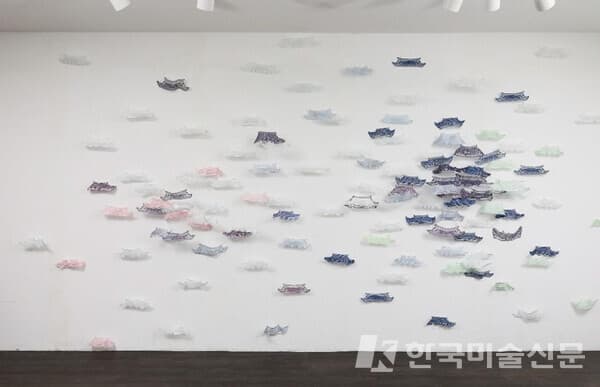
▲ 이상영, Embroidery, polyester, rayon thread(자수, 폴리에리터, 레이온사)가변설치, 2021 (사진=키미아트)
이상영 작가는 섬유를 소재로 하여 독특한 설치 공간을 만들어내는 작업을 해오고 있다. 이번 전시에서도 작가는 반투명한 섬유에 바느질로 한옥 이미지를 넣은 작은 개체들로 전시장 벽을 가득 채우거나 이를 아크릴 박스 안에 넣어 투명한 부분과 반사되는 부분이 겹쳐지면서 신비로운 공간을 연출해내는 다양한 작업을 보여주고 있다. 작가는 이와 같은 작업에서 특별히 한옥 지붕의 형상을 중심적 이미지로 부각시키는 것이 눈에 띄는데 그 방법은 한옥 이미지를 얇은 천에 올려 개체화하고 이를 공간 속에서 반투명한 재질의 천이 수없이 겹쳐지거나 나열되도록 함으로써 반복과 중첩이 계속되도록 만드는 방식과 이를 일종의 거울방과 같은 아크릴 박스 속에서 이미지가 반사되거나 투과되는 상황 속에 넣어 두는 방식 등과 같은 것들이다. 그 결과 작업 속의 한옥 이미지는 지속적으로 반복되고 중첩되면서 현실 속 한옥 지붕을 지시하던 이미지는 어느새 현실 너머의 가상과 상상 공간 속을 부유하고 있는 것 같은 느낌으로 다가오는 것을 느낄 수 있게 만들고 있다.
작가가 작업에 한옥 이미지를 가져오게 된 것은 자신이 어린 시절 살았던 공간이었고 자신의 정체성을 드러낼 수 있는 이미지이었기 때문이라고 한다. 작가에게 한옥은 어린 시절의 경험했던 모든 것들이 담겨 있는 공간이자 작가 자신과 동일시할 수 있는 이미지로 여겨왔던 것이다. 그런데 전시 공간에서 만나게 되는 한옥의 이미지는 하나의 단일한 한옥 지붕의 이미지가 아니라 반복과 중첩 속에서 만나게 되는 수없이 많은 중첩된 이미지들이며 다양한 각도로 반영된 여러 측면들과 시선에 따른 변화가 관찰될 수 있는 상태의 이미지들이다. 전시에서 만나게 되는 작업들과 함께 그의 작가노트를 살펴보면 작가는 그의 작업을 해나가는 가운데 어린 시절의 기억이자 자신에게는 유토피아로 여겨졌던 한옥으로 된 집에서의 삶이 현재에는 더 이상 유토피아일 수만은 없다는 생각을 하게 되었던 것으로 보인다. 팬데믹 시대에 더욱 실감하게 된 소외와 결핍, 주체와 타자성의 관계와 같은 문제들이 과거 기억들과 교차되는 경험을 하게 되면서 보이지 않았던 부분, 다른 측면들을 발견하게 되었던 것이고, 그 결과 작가는 투명하거나 반투명한 상태에서, 반사되거나 투과되어 보이는 한옥의 이미지로부터 자신의 기억에 대해, 그리고 자신의 정체성이자 유토피아로 여겼던 작가 자신의 삶의 영역과 자신을 둘러싸고 있는 사회적 영역들을 새롭게 바라보는 방법을 찾아가게 되었던 것으로 보이기 때문이다.
그래서 작가는 이제 그 어린 시절의 기억 공간을 소환하여 현재를 더 깊이 사유할 수 있는 장으로 연장시키거나 더 나아가 맞닥뜨린 현재의 삶으로부터 도약할 수 있는 지렛대로 삼고자 하는 것으로 보인다. 그것은 작가의 작업에서 보여주는 것처럼 가상적인 공간, 혹은 상상력으로 만들어낸 관계적 공간으로 변형과 변이의 과정을 거치는 것이 필요한 것일 수도 있다. 같은 구조가 반복되고 중첩되면서 유사성과 차별성은 명료해지게 되고 기억의 공간은 상상의 공간으로 연장되면서 미완의 유토피아는 또 다시 꿈을 꿀 수 있는 지점에 이르게 된 것으로 보인다. 작가는 이 지점에서 타자를 그리고 자기 자신을 새로운 관계망 속에서 바라보기를 원하는 것으로 보인다. 그렇기에 작가는 이번 전시에서 그러한 시선이 머무는 장소를, 그리고 그러한 사유가 머무는 장소를 만들어내고자 하였던 것으로 보인다. 그리고 그 장소에서 깊은 사유의 시간, 상상의 시간을 함께 할 수 있도록 관객들에게 독특한 설치작업과 오브제 작업을 통해 초대의 메시지를 전해주고 있는 것 같다.
글. 이승훈 미술비평가
<편집자 주 : 본 미술 평론은 독자들의 작품 이해도를 높이고 미술 정보 전달을 위한 비상업적인 목적입니다. 저작권은 평론가에게 있습니다.>
Artist Lee Sang-young has been working on creating unique installation spaces using textiles as a material. In this exhibition, the artist shows a variety of works in which the walls of the exhibition hall are filled with small objects with images of hanok sewn onto translucent fibers or placed in an acrylic box to create a mysterious space where the transparent and reflective parts overlap. . In this work, it is particularly noticeable that the artist highlights the shape of the roof of a hanok as a central image. The method is to individualize the image of a hanok by placing it on a thin fabric and placing it in space by overlapping or arranging countless translucent fabrics. Such as the way to make repetition and overlap continue, and the way to put it in a situation where the image is reflected or transmitted in an acrylic box like a kind of mirror room. As a result, the hanok image in the work is continuously repeated and overlapped, making it possible to feel that the image pointing to the roof of the hanok in reality is approaching as if it is floating in a virtual and imaginary space beyond reality.
It is said that the reason why the artist brought the image of hanok to his work is that it was the space he lived in as a child and it was an image that could reveal his identity. For the artist, hanok has been regarded as a space that contains all the experiences of childhood and an image that can be identified with the artist himself. However, the image of a hanok encountered in the exhibition space is not a single image of a hanok roof, but countless overlapping images encountered through repetition and overlap, and various aspects reflected from various angles and changes depending on the gaze can be observed. These are images of the present state. Looking at his artist's notes along with the works encountered in the exhibition, the artist realizes that life in a hanok house, which was considered a utopia to him as a childhood memory, can no longer be a utopia in the midst of his work. seems to have been done As he experienced problems such as alienation and deficiency, the relationship between the subject and otherness, which became more real in the era of pandemic, intersecting with past memories, he discovered the invisible part and other aspects. As a result, the artist is transparent or translucent In one state, he found a new way to look at his memory from the image of a hanok that is reflected or transmitted, and the realm of his own life and the social realm surrounding him, which he regarded as his identity and utopia. because it looks
So, it seems that the artist is now trying to summon the memory space of his childhood and extend it into a field where he can contemplate the present more deeply, or furthermore, use it as a lever to leap forward from the present life he encounters. As shown in the artist's work, it may be a virtual space or a relational space created by imagination, which requires going through the process of transformation and transformation. As the same structure is repeated and overlapped, similarities and differences become clear, and as the space of memory extends into the space of imagination, it seems that the unfinished utopia has reached a point where you can dream again. At this point, the artist seems to want to see others and himself in a new network of relationships. That is why the artist seems to have tried to create a place where such a gaze stays and a place where such thoughts stay in this exhibition. And it seems to be delivering a message of invitation through unique installation work and object work to the audience so that they can spend time of deep thought and imagination together in that place.