
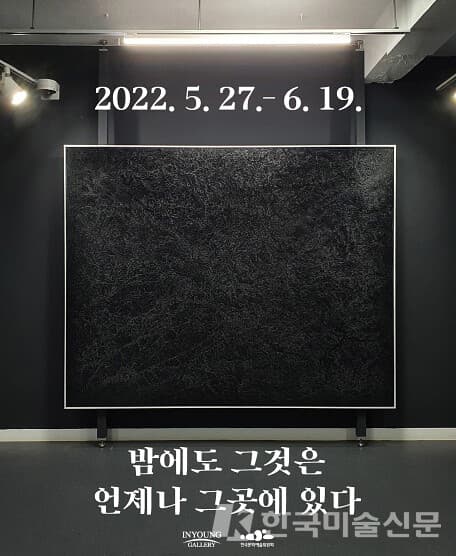
산등성이를 타고 밤이 깔린다. 수백 번의 붓질이 지나간다. 마른 짐승의 등골처럼 움푹 패인 곳이 있는가 하면, 우둘투둘하게 솟아난 곳도 있다. 튀어나온 자리마다 희미한 은빛이 감돈다. 저만치 위로 폭포 소리가 들린다. 솨아아- 떨어지는 물줄기는 빛줄기가 되어 어둠의 베일을 들춘다. 수심(水深)은 마음의 깊이와 같고, 수천 개의 물방울이 측정할 길 없는 심연으로 스며든다.
김현호의 산수(山水)는 견고한 표면 너머로 “심리적인 배면(背面)”1 을 간직하고 있다. 겹겹이 도포한 카본 블랙 층 아래에는 오직 흑과 백으로 구성된 자연이 존재한다. 눈을 현혹하는 색들을 미련없이 걷어 내면서 맞아들인 세계다. 비움으로써 고요해진 화면은 화려함 대신 깊이를 얻었다. 그 깊이, 미세한 명암의 차이에 따라 무수한 사이-공간이 열린다. 관객은 저마다 마음이 이끄는 곳으로 걸어 들어간다. 한 사람 한 사람의 마음속 사원(寺院)에 불이 들어온다.
이 명상적인 그림들은 낯선 세계를 열어 보이면서 동시에 거두어 들인다. 언뜻 나타난 세계는 백일하에 드러난 자연이 아니다. 숨 멎는 암흑 속에서 은밀히 빛나는 자연이다. H. 롬바흐의 말마따나, 빛에 대한 감수성이 예민한 사람은 낮의 빛보다 아침의 빛을, 아침의 빛보다 밤의 빛을 높이 평가한다. “밤이 낮보다 더 근원적이지 않은가? 빛이 빛일 수 있기 위해서는 결국 보다 광대한 어둠으로부터 빛나 오르는 것이어야만 하지 않는가? (…) 존재는 모든 것에 선행하는 무에 대항하면서 자신을 두드러지게 함으로써 비로소 존재하는 것이 아닌가?”2 김현호의 화폭에서 산과 폭포는 어둠으로부터 “융기”한다. 이는 곧 “부활”이며, “내 마음대로 다룰 수 없는 것, 타자인 것, 사라지는 도중에 있는 것이 몸 자체 안에서, 몸으로서 돌출하는 것이다.”3
그림 속 자연은 접촉을 유도하면서 밀어낸다. “나를 만지지 마라.” 헤르메스적 시인의 눈을 가진 관객은 “이해(verstehen)”하지 않는다. “그는 본다.”4 이 무지막지한 어둠, 깊이를 가늠할 수 없는 미지(未知)의 영역을 그저 받아들인다. 이 역설은 타자와 나, 자연과 인간 사이에 신성한 거리를 설정하는 문제와 관련된다. “어떤 물러남, 거리, 변별 그리고 ‘측정할 수 없음’을 보여주는 것이 있는 곳이라면” 어디든 나타난다.5
내가 모르는 세계가 있다는 것, 밤이 오지 않을 수 없다는 것, 빛보다 어둠이 근원적이라는 것. 이 자명한 사실을 보다 편안한 마음으로 인정할 수 있을까? 서구의 몇몇 사상가들이 주장했던 것과 달리, 자연의 존재 여부는 나의 인식에 달려 있지 않다. 자연은 온전히 거기에 실재한다. 내가 바라보거나 말거나, ‘언제나 그곳에 있다.’ 자연의 절대적인 출현 앞에서 우리는 말문이 막힌다. 이해를 넘어서는 지점을 목도한다. 그럼에도 두렵지 않다. 우리의 몸을 천천히 감싸는 어둠에서 빛다운 빛과 조우할 수 있기에. 그렇다면 더 이상 “어둠 속에서 보는 게 문제가 아니다. 더 나아가 어둠에도 불구하고 보는 게 문제가 아니다(…) 중요한 것은 어둠 안에서 눈을 여는 것이다.”6
1 르네 위그, 『보이는 것과의 대화』, 곽광수 옮김, 열화당, 2017, p.117.
2 H. 롬바흐, 『아폴론적 세계와 헤르메스적 세계』, 전동진 옮김, 서광사, 2001, pp.38-39.
3 장-뤽 낭시, 『나를 만지지 마라』, 이만형∙정과리 옮김, 문학과지성사, 2015, p.33.
4 H. 롬바흐, op. cit., p.35.
5 장-뤽 낭시, op. cit., p.29.
6 ibid., p.76.
글. 홍예지 독립큐레이터
<편집자 주 : 본 미술 평론은 독자들의 작품 이해도를 높이고 미술 정보 전달을 위한 비상업적인 목적입니다. 저작권은 평론가에게 있습니다.>
Night falls over the ridge. Hundreds of brushstrokes pass by. There are hollow places like the spines of skinny animals, and there are also rugged places. A faint silver light hangs over every protruding spot. I can hear the sound of a waterfall from above. Shaaa- The falling stream of water becomes a beam of light and lifts the veil of darkness. The depth of the water is equal to the depth of the heart, and thousands of droplets sink into the immeasurable abyss.
Hyunho Kim's landscapes contain a “psychological back”1 beyond the solid surface. Under the carbon black layer applied layer by layer, there is nature composed only of black and white. It is a world welcomed by removing the colors that dazzle the eyes without hesitation. The screen, which became quiet by emptying, gained depth instead of splendor. Innumerable in-between spaces are opened according to the depth and subtle differences in light and shade. The audience walks where their heart leads them. The temple in each person's heart lights up.
These meditative paintings open up to an unfamiliar world and at the same time reap it. The world that appears at first glance is not nature revealed under one day. It is nature that secretly shines in the suffocating darkness. As H. Rombach said, a person who is sensitive to light appreciates the light of the morning rather than the light of the day, and the light of the night rather than the light of the morning. “Is not the night more fundamental than the day? In order for light to be light, after all, shouldn't it be something that shines from a more vast darkness? (...) Doesn't existence exist only by standing out against nothingness that precedes everything? This is “resurrection,” and “what I cannot control, what is the other, and what is on the way to disappear, protrudes from within the body itself, as the body.”3
Nature in the painting induces contact and pushes it away. “Don’t touch me.” The spectator with the eyes of a Hermetic poet does not "understand" (verstehen). “He sees.” 4 Just accept this immense darkness, an unknown realm whose depth cannot be fathomed. This paradox is related to the issue of establishing a sacred distance between the other and me, between nature and human beings. It appears “wherever there is some withdrawal, some distance, some distinction and some indication of 'immeasurability'.”5
That there is a world I don't know about, that night must come, and that darkness is more fundamental than light. Can this self-evident fact be acknowledged more comfortably? Contrary to what some Western thinkers have argued, the existence of nature does not depend on my perception. Nature is fully there. Whether I look at it or not, 'it's always there.' We are speechless before the absolute appearance of nature. Witness the point beyond understanding. not afraid though Because we can encounter the light that shines in the darkness that slowly envelops our bodies. Then “seeing in the dark is no longer a problem. Furthermore, seeing despite the darkness is not a problem (…) The important thing is to open your eyes in the dark.”6
1 René Huygues, 『Dialogue with the visible』, translated by Kwak Kwang-soo, Yeolhwadang, 2017, p.117.
2 H. Lombach, 『The Apollonian World and the Hermetic World』, translated by Jeon Dong-jin, Seogwangsa, 2001, pp.38-39.
Chapter 3 - Luc Nancy, Don't Touch Me, Translated by Lee Man-hyung and Jung Gwa-ri, Literature and Intelligence, 2015, p.33.
4 H. Lombach, op. cit., p. 35.
Chapter 5 - Luc Nancy, op. cit., p. 29.
6 ibid., p. 76.
(번역=한국미술신문)
■ 작가소개
|
|||